An order comes in. Someone checks it. Inventory gets updated. A pick ticket is created. The right product has to reach the right packing station, get packed correctly, receive a shipping label and move out the door. Do every step manually and small delays add up fast.
Automation in fulfillment uses connected software, systems and equipment to complete repeatable parts of the fulfillment process with less manual work. Done well, it helps orders move faster, reduces opportunities for human error and gives your team more capacity as order volume grows.
But automation does not mean putting a robot in every aisle. That distinction matters.
Key Takeaways
Automation in Fulfillment
The use of technology to complete or direct repeatable steps in the order fulfillment process with less manual work. It can include software, connected systems, scanning technology and physical warehouse equipment.
Automation in Fulfillment Saves Time
Automated processes reduce the number of routine fulfillment tasks that have to be completed manually.
Automation Can Speed Up Fulfillment
Moving repeatable steps through an automated workflow helps orders progress through fulfillment faster.
Automation Helps Reduce Human Error
Fewer manual steps mean fewer opportunities for mistakes during routine fulfillment processes.
Automated Fulfillment Supports Growth
Automating repetitive work can make it easier to handle higher order volume without creating the same increase in manual work.
What Is Automation in Fulfillment?
Automation in fulfillment means using technology to move orders through predictable steps with fewer manual handoffs. It can begin when an order enters the fulfillment system and continue through inventory allocation, picking, packing, shipping and tracking.
Fulfillment automation: The use of software, connected systems or equipment to complete repeatable fulfillment tasks with less manual intervention.
That definition is broader than warehouse robotics.
Software can automatically import an ecommerce order, update inventory, select a warehouse workflow or apply shipping rules. Barcode scanners can confirm that the correct SKU was picked. A warehouse management system can direct the next task. Physical automation can move products or containers through parts of the facility.
Robots are one tool. They are not the definition.
That distinction is becoming more important as adoption grows. In 2026, a reported 35% of organizations currently use robotics and automation, while another 38% expect to implement them within five years.
How Does Automated Fulfillment Work?
Automated fulfillment works by connecting order data with rules that tell systems and warehouse teams what should happen next. Instead of repeatedly entering, checking or moving the same information by hand, connected systems pass it through the fulfillment process.
The exact workflow depends on the operation.
Orders and Inventory Move Between Connected Systems
Automation starts with reliable data. Your ecommerce platform, order management system and warehouse management system need to exchange the right information at the right time.
When a customer places an order, an integrated workflow can send that order into the fulfillment system automatically. Inventory can update as units are allocated or shipped. Warehouse instructions can be created without someone retyping the order.
That removes unnecessary handoffs. It also matters because automation cannot compensate for bad source data. If inventory counts, SKUs or order information are wrong, automating the workflow can simply move the wrong information faster.
System integration: The connection between platforms that allows order, inventory, warehouse and shipping data to move between them without repeated manual entry.
Automation Directs Warehouse Work
Once an order reaches the warehouse, automation can help determine what happens next. The system may create pick tasks, direct a worker to the correct location, verify a barcode, apply packing rules or generate shipping information.
Physical automation can go further. Conveyors, automated storage systems, robotic equipment and autonomous mobile robots can help move goods through portions of the warehouse.
The goal is not automation for its own sake. The goal is to remove unnecessary movement, repeated decisions and manual steps that slow orders down.
What Parts of Fulfillment Can Be Automated?
Many repeatable fulfillment tasks can be automated without automating the entire warehouse. The best opportunities are usually processes that happen frequently and follow clear rules.
Common examples include:
- Importing orders from ecommerce and marketplace channels
- Updating inventory across connected systems
- Creating and prioritizing warehouse tasks
- Directing pick paths and locations
- Verifying products through barcode scanning
- Applying packing instructions
- Selecting shipping services based on predefined rules
- Creating shipping labels
- Returning tracking information to the selling channel
- Flagging orders that require additional attention
This is where software automation often creates value before more expensive physical automation is considered.
What Are the Benefits of Automation in Fulfillment?
The biggest benefits are not the technology itself. They are what the technology removes from the process.
Less waiting. Less repeated work. Fewer unnecessary decisions.
Faster Processing With Fewer Manual Handoffs
Orders can move faster when systems handle predictable steps without waiting for someone to transfer data or make the same routine decision again.
Order picking deserves particular attention because it can consume a large share of warehouse resources. A widely cited warehouse research review estimated that picking can account for up to 55% of total warehouse operating expense, although the benchmark comes from a 2007 academic review and operating models have changed significantly since then.
Modern automation focuses heavily on reducing the walking, searching, routing and repeated handling that make picking expensive.
More Consistent Order Accuracy
Automation reduces the number of places where a routine manual mistake can enter the process.
A scanner can confirm a SKU before it moves forward. A WMS can provide the correct location rather than relying on memory. Integrated systems can move order information without someone typing it again.
That does not make errors impossible. It makes the process more controlled.
A 2025 study looked at roughly three million manual picks performed by more than 500 warehouse pickers. Researchers found that task and human factors contributed to deviations in picking order and execution time, affecting predictability and efficiency.
More Capacity Without Adding Manual Work at the Same Rate
Growth should not require adding another manual step every time order volume increases.
Automation allows repeatable tasks to process through established rules, while employees focus on work that requires judgment. That becomes especially valuable during promotions, product launches and peak season when order volume can change quickly.
The result is a fulfillment operation that has more room to scale.
Does Fulfillment Automation Replace People?
Good fulfillment automation changes what people spend their time doing. It does not eliminate the need for operational judgment. Routine work is the easiest work to automate. Exceptions are different. An unusual order may need inspection. Inventory may not match the system. A product may require special packaging. An order could arrive with incomplete information.
Those situations require people who understand the operation.
Exception management: The process of identifying orders or inventory issues that fall outside the normal workflow so a person can resolve them before they create a larger problem.
Automation works best when normal orders move efficiently and exceptions become easier to see. That is a much more useful goal than trying to remove people from every step.
More Automation Is Not Always Better
The right amount of automation depends on the workflow. Adding more technology without considering layout, order profile, congestion and existing processes can create new problems instead of fixing old ones. There is research behind that point.
A 2025 study evaluated 140,991 warehouse pick-location visits in an operation where automated guided vehicles worked alongside manual pickers. Researchers found a U-shaped relationship between the share of AGVs and picking time. Their conclusion was clear. More automation did not automatically mean better picking performance.
Another 2026 study analyzed 490,398 pick events and found AGV assistance could reduce delays caused by certain types of picker blocking. The effect depended on the specific warehouse condition. That is the real lesson.
Start with the problem. Then choose the technology.
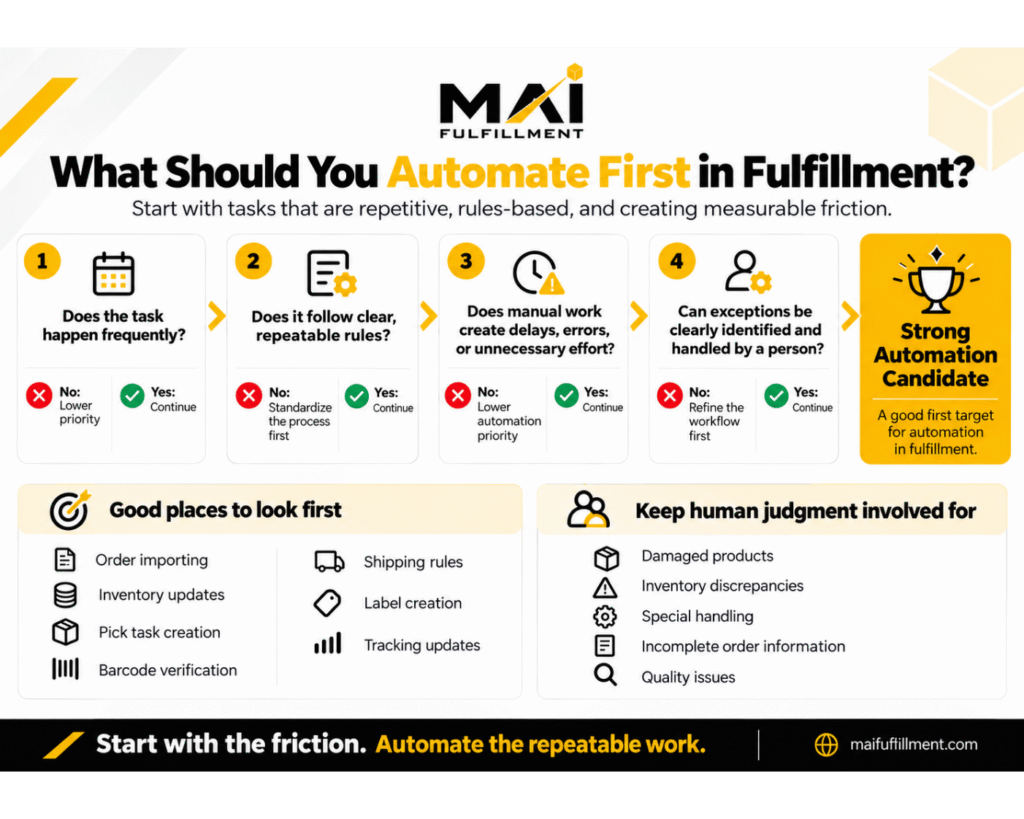
How Do You Know What to Automate First?
Start with bottlenecks and repeatable work. Look for places where your team spends time making the same decision, entering the same information or correcting the same preventable problem.
Ask a few practical questions.
- Where do orders wait?
- Which tasks require repeated manual entry?
- Where do picking or packing errors happen?
- Which processes become difficult when order volume spikes?
- Where are employees spending time walking, searching or checking?
- Which decisions can be turned into clear rules?
- Which exceptions still require human judgment?
MHI similarly recommends identifying the operational problem first rather than selecting technology and then searching for a use for it.
The best first automation is often the one that removes a known bottleneck.
How a Technology-Driven 3PL Supports Fulfillment Automation
You do not have to build an automated warehouse yourself to benefit from automated fulfillment. A technology-driven 3PL can provide the systems, integrations, warehouse processes and infrastructure needed to automate parts of the order flow while your team stays focused on the brand.
At MAI, automation is useful when it produces a real operational result. Orders move with fewer manual handoffs. Inventory stays visible. Warehouse teams receive clear instructions. Repeatable processes stay consistent as volume changes.
Technology should make fulfillment easier to manage, not harder.
Build Automation Around the Operation
Automation in fulfillment works best when technology solves a specific operational problem. It can speed up repeatable processes, save your team time, reduce opportunities for human error and create more capacity for growth. But automation is not a contest to see how many systems or robots you can add.
Start with the friction. Connect the right data. Automate the repeatable work. Keep people focused where judgment still matters.
That is how automation becomes an operational advantage instead of another layer of complexity.
Automation in Fulfillment FAQs
Can fulfillment automation work with multiple ecommerce sales channels?
Yes. Connected fulfillment systems can receive orders from multiple ecommerce platforms and marketplaces and route them into a centralized fulfillment workflow. The exact capabilities depend on the integrations supported by the ecommerce platform, OMS, WMS or fulfillment provider.
Does fulfillment automation require artificial intelligence?
No. Many useful fulfillment automations rely on predefined rules, system integrations, barcode scanning and warehouse management software rather than artificial intelligence. AI can support forecasting, optimization and more complex decisions, but it is not required for basic fulfillment automation.