
Orders are coming in. That is the goal.
But growth gets complicated when your team spends more of each day receiving inventory, finding SKUs, packing boxes, printing labels, fixing order errors, and answering delivery questions. At some point, fulfillment stops being a task in the background and starts taking attention away from your customers and your business.
That is where E-commerce Businesses Fulfillment Services can make a difference. The right fulfillment operation gives you the systems, warehouse capacity, technology, and people to manage orders without forcing your internal team to build a logistics operation from scratch.
U.S. ecommerce sales reached $340.2 billion in the second quarter of 2026, up 12.2% from the same quarter in 2025, according to the U.S. Census Bureau. More online sales create opportunity, but they also put more pressure on the operations behind every order.
Key Takeaways
Ecommerce fulfillment services
Managing the operational steps required to get an online order from inventory to the customer. Depending on the provider, that can include receiving, storage, inventory management, picking, packing, shipping, tracking, and returns.
Ecommerce fulfillment protects your team's time
Outsourcing repeatable warehouse work gives your team more time to focus on customers, products, marketing, and growth.
Efficiency matters as order volume grows
Defined receiving, inventory, pick and pack, shipping, and returns processes help prevent small operational problems from multiplying.
Fulfillment gives growing brands room to scale
A professional operation can add capacity without requiring you to build warehouse space, staffing, systems, and processes yourself.
Customer satisfaction depends on what happens after checkout
Accurate orders, reasonable shipping options, reliable delivery, tracking, and returns all affect the customer's experience.
Technology gives you better fulfillment visibility
Connected order and inventory systems help you see what is available, what has shipped, and where problems need attention.
What Are Ecommerce Fulfillment Services?
Ecommerce fulfillment services handle the physical and operational work required after customers place orders. Instead of storing inventory and processing every shipment internally, a business can use a fulfillment provider or third-party logistics company to manage those workflows.
Ecommerce fulfillment: The process of receiving, storing, picking, packing, shipping, and managing orders sold through ecommerce channels.
That distinction matters because fulfillment is much bigger than shipping. Shipping moves a finished parcel from one location to another. Fulfillment determines whether the correct product is available, picked accurately, packed properly, processed on time, and handed to the right carrier.
For a growing ecommerce business, every one of those steps has to keep working as volume and complexity increase.
1. Fulfillment Services Give Your Team Time Back
Outsourcing fulfillment removes repeatable warehouse work from your internal team’s workload. That creates more capacity for work only your team can do, including improving products, supporting customers, building demand, managing channels, and planning growth.
That dependency matters. A receiving mistake can become an inventory problem. An inventory problem can become a short pick or wrong order. The customer sees the final error, even if it began several steps earlier.
Where Your Team's Time Actually Goes
Self-fulfillment can look manageable when volume is low. Then the work starts stacking up. Inventory has to be received and counted. Orders need to be picked. Boxes need to be packed. Labels have to be generated. Carrier pickups need attention. Returns come back. Inventory records need updating.
None of those jobs disappears when your marketing works and that creates a real opportunity cost. Time spent solving routine fulfillment problems is time your team cannot spend improving the customer experience or moving the business forward.
A fulfillment partner takes responsibility for those repeatable processes while your team keeps control of the brand, product, and customer strategy.
2. Professional Fulfillment Improves Operational Efficiency
Professional fulfillment creates repeatable processes for receiving, inventory, order processing, pick and pack, shipping, and returns. The goal is not simply to work faster. It is to make fulfillment more predictable as order volume, SKU count, and sales channels grow.
Order accuracy: The ability to send the correct products and quantities to the correct customer without picking, packing, or inventory errors.
Good fulfillment depends on details. A receiving mistake can create an inventory discrepancy. Bad inventory data can lead to an order for a product that is not actually available. A rushed pick can become a wrong shipment. A slow handoff can turn into a late delivery. Customers never see most warehouse processes, but they feel the results.
That is why fulfillment efficiency should be measured by more than boxes packed per hour. Brands should also watch inventory accuracy, order accuracy, processing time, shipping performance, returns, and the customer-service issues tied back to fulfillment.
3. Fulfillment Services Make Ecommerce Growth Easier to Manage
Growth requires capacity before you need it. A fulfillment partner can provide warehouse space, labor, systems, and established workflows without forcing your company to build each capability internally every time volume increases.
This matters during product launches, promotions, holidays, and other demand spikes.
Order Volume Is Only One Sign You Have Outgrown Self-Fulfillment
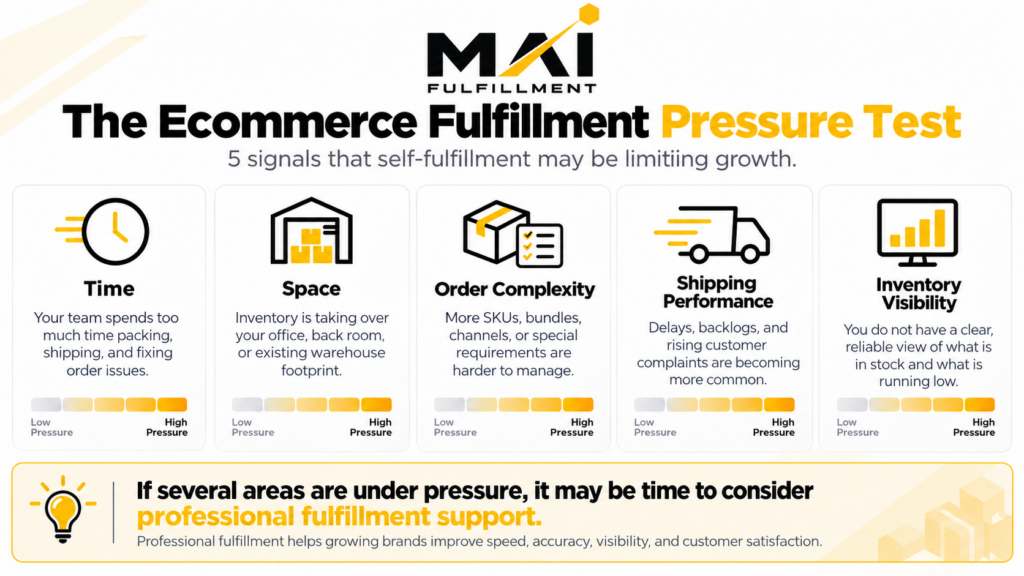
There is no universal order count that means every brand should hire a 3PL. Complexity matters too. A business may need outside fulfillment support when:
- Inventory is consuming more physical space.
- Order processing is pulling key employees away from higher-value work.
- Promotions create fulfillment backlogs.
- SKU growth makes inventory harder to manage.
- Multiple sales channels create manual work.
- Shipping errors or delays are increasing.
- Hiring enough warehouse labor becomes difficult.
The better question is not simply, “How many orders do we ship?” Ask whether your current fulfillment operation can handle the next stage of growth without sacrificing accuracy, speed, visibility, or customer experience.
Scalable fulfillment: A fulfillment operation that can handle changing order volume and complexity without requiring the brand to rebuild its logistics process each time it grows.
4. Better Fulfillment Supports Customer Satisfaction
Fulfillment is one of the few parts of ecommerce that becomes physical. The customer paid for a product on a screen, but what arrives at the door shapes how that purchase is remembered. Cost matters and so does timing.
40% of shoppers cited high extra costs such as shipping and taxes as a reason for abandonment. Another 20% cited slow delivery. 76% of consumers said free shipping influences purchase decisions throughout the year.
Your fulfillment strategy affects your ability to control those issues through warehouse placement, carrier selection, packaging, processing speed, and shipping options.
Then there is accuracy. A package that arrives quickly does not create a good experience if it contains the wrong item. Strong fulfillment keeps speed and accuracy connected rather than treating either one as the only goal.
Returns Are Part of Fulfillment Too
The customer experience does not always end with delivery. Returns need a clear operational process as well.
The National Retail Federation projected that 19.3% of online sales would be returned in 2025. Its research also found that 71% of consumers said they were less likely to shop with a retailer again after a poor returns experience.
Returned inventory needs to be received, inspected, tracked, and given the correct disposition. When that process is slow or unclear, customer-service work grows and usable inventory can sit outside available stock longer than necessary.
5. Connected Fulfillment Technology Gives You Better Control
Outsourcing physical fulfillment should not mean losing visibility. The right technology gives you a clearer view of orders and inventory while the warehouse handles the physical work.
Modern fulfillment systems can connect ecommerce orders with warehouse inventory and shipping activity. Instead of passing information through spreadsheets, emails, or manual updates, data can move between sales platforms and warehouse systems automatically. That matters when you sell through more than one channel.
Better visibility helps your team answer practical questions faster. What inventory is available? Which orders have shipped? What is waiting to be received? Where are stock levels getting low? Did tracking information make it back to the sales channel?
Technology should make those answers easier to find. It should not create another system your team has to babysit.
Is Professional Fulfillment Right for Your Ecommerce Business?
Professional fulfillment makes the most sense when handling logistics internally starts limiting what your team can accomplish elsewhere. The trigger could be order volume, space, staffing, inventory complexity, channel growth, customer expectations, or several of those pressures at once.
Do not judge a fulfillment partner on warehouse space alone. Look at how the provider handles inventory visibility, integrations, order accuracy, peak periods, customer communication, returns, and the types of orders your business actually ships. Your operation may need DTC today and B2B or retail tomorrow.
The goal is not to hand over control but to build an operation that gives you better control without requiring your internal team to execute every physical step.
For growing brands evaluating e-commerce businesses fulfillment services, that is the real value of outsourcing. Fulfillment should give your business the capacity to serve customers well today while making the next stage of growth easier to manage.
With MAI, fulfillment is built around the way your business actually operates. We help growing brands manage inventory, orders, channels, and fulfillment complexity so their teams can stay focused on customers and growth.
Ecommerce Fulfillment FAQs
Can an ecommerce fulfillment provider support custom packaging?
Many fulfillment operations can support branded packaging, inserts, special packing instructions, and other custom workflows when those requirements are documented before launch. Capabilities vary by provider, so brands should confirm packaging materials, storage requirements, labor charges, and quality-control procedures during evaluation.
Can one fulfillment provider handle both DTC and B2B orders?
Some 3PLs support both individual consumer orders and larger wholesale or retail shipments from shared inventory. B2B fulfillment may require additional processes such as routing guides, labeling, pallet configuration, EDI, appointment scheduling, and retailer-specific documentation.
Do ecommerce fulfillment services connect with online stores?
Many modern fulfillment providers connect warehouse systems with ecommerce platforms and marketplaces so order and inventory data can move automatically. Brands should verify the specific integrations they need and understand how orders, inventory, cancellations, returns, and tracking information move between systems.
What information does a fulfillment provider need before onboarding?
A provider typically needs information about SKUs, inventory quantities, historical and projected order volume, sales channels, packaging, shipping requirements, returns, and any special handling workflows. Better data before onboarding helps the warehouse design receiving, storage, picking, packing, and technology processes around the actual operation.
Can fulfillment services support kitting or product bundles?
Some fulfillment providers can assemble kits, bundles, promotional packs, subscription configurations, or other multi-item orders before or during order processing. Brands should confirm how component inventory is tracked and how assembly work affects lead times, inventory visibility, and fulfillment charges.