
Key Takeaways
Kitting means grouping multiple items into one ready-to-ship unit.
The finished kit is usually assigned its own SKU, stored in a set warehouse location, and picked as one item when an order is placed.
Kitting can make fulfillment faster and more accurate.
Because the kit is prepared before the order comes in, the warehouse has fewer items to pick and fewer chances to miss a component.
Inventory visibility is critical.
Your fulfillment system needs to track both the finished kit and the individual products inside it, or you risk overselling, stockouts, and reporting issues.
Pre-kitting and just-in-time kitting solve different problems.
Pre-kitting works well for predictable demand. Just-in-time kitting gives you more flexibility when products are sold both individually and as part of a set.
The right 3PL should manage the full kitting workflow.
That includes SKU setup, barcode scanning, packaging, inserts, labeling, quality checks, channel requirements, and inventory reporting.
Kitting Explained
Kitting is the warehouse process of combining multiple products or components into one finished, ready-to-ship unit.
Once assembled, the completed kit is usually assigned its own SKU. The warehouse can then store, count, pick, and ship it as one item while continuing to track the individual components used to build it.
For example, a skincare set may contain a cleanser, serum, moisturizer, branded insert, and custom box. Instead of picking those five components separately every time the set is ordered, the warehouse can assemble and quality-check the full kit in advance.
That reduces repeated handling, but it also creates an important inventory connection. Your fulfillment system needs to know both:
- How many finished kits are available
- How many individual components remain
Without that connection, kitting can create inaccurate inventory counts even when the physical assembly process is working correctly.
Signs Your Current Fulfillment Process May Need Kitting
Kitting is not automatically the right answer for every multi-item order. It becomes valuable when repeated assembly work starts slowing down the rest of fulfillment.
For brands selling across DTC, wholesale, retail, marketplaces, and subscription channels, that control matters. Every channel has its own rules, timelines, and packaging expectations. Kitting helps standardize the work before volume hits.
Your operation may be ready for kitting when:
The Same Products Are Picked Together Repeatedly
Packing Instructions Are Becoming Too Complicated
Promotions Are Disrupting Normal Fulfillment
Product launches, holiday sets, influencer campaigns, and limited-time offers can create a sudden wave of multi-item orders. Preparing kits before the campaign launches helps protect the normal pick-and-pack operation from avoidable congestion.
Missing Components Are Creating Customer Service Issues
When products are picked individually, one missed item can turn an otherwise successful shipment into a refund, reshipment, or poor review.
A kit can be assembled and checked as one complete unit before it becomes available for fulfillment.
Your Team Cannot Clearly See How Many Bundles Are Available
Selling products individually and as part of a bundle can make availability difficult to calculate. A connected kitting workflow helps your team understand how many kits are already built, how many more can be assembled, and which component is limiting availability.
Retail or Marketplace Requirements Are Adding More Steps
A product combination that works for your ecommerce store may require a different barcode, label, package, case pack, or insert for another channel.
Building channel-specific kits gives the warehouse a repeatable way to manage those differences without relying on last-minute instructions.
The question is not simply whether products can be grouped together. The question is whether grouping them in advance removes enough repeated work, risk, or complexity to improve the operation.
“Kitting is never just putting products together. When a brand is selling across ecommerce, wholesale, retail, and marketplaces, every kit has to be accurate, trackable, and ready to move without slowing the operation down. The right process upfront protects inventory visibility, shipping speed, and the customer experience all at once.”
Tracy DiAngelo, MAI Fulfillment
What is the Difference Between Kitting, Bundling and Assembly?
What is Kitting?
Kitting means multiple items are grouped together before fulfillment and treated as one unit. A finished kit often has its own SKU. The warehouse can pick that finished unit instead of picking every component separately.
Example: A skincare kit with cleanser, toner, moisturizer, and serum packed together ahead of time.
What is Bundling?
Bundling is usually a sales or merchandising strategy. It means multiple products are sold together as one offer. A bundle may be pre-kitted, but it does not have to be. Some bundles are assembled during pick and pack after the order is placed.
Example: A “buy the full routine” offer on a Shopify store where the warehouse still picks each product separately.
What is Assembly?
Assembly usually involves putting parts together or preparing a product before it is ready to sell or ship. This may include building a display, applying labels, adding accessories, inserting instructions, or preparing components that arrive separately.
Example: A kitchen gadget that arrives in multiple pieces and needs to be packaged with accessories and instructions before shipment.
The difference matters because each workflow affects inventory, labor, storage, and cost. A simple bundle may only need standard pick and pack. A true kit may require new SKU setup, batch production, quality checks, packaging rules, and real-time inventory tracking.
Common Examples of Product Kitting
Kitting is useful when products are frequently sold together or need a consistent presentation. Here are seven common examples of types of kitting projects:
Subscription Boxes
Subscription boxes are one of the most common uses for kitting.
Each box may include multiple products, samples, printed materials, inserts, or promotional items. Because subscribers usually receive the same set or a planned variation, the warehouse can build the boxes in batches before orders ship.
This helps control quality, presentation, and timing.
Gift Sets
Gift sets are especially common during holidays, product launches, and seasonal campaigns.
These kits often need stronger attention to packaging and presentation. The customer may be buying the item as a gift, so the unboxing experience needs to feel intentional.
Promotional Bundles
Promotional kits can support limited-time offers, influencer campaigns, product launches, or retail programs.
The warehouse may need to build these quickly, follow campaign-specific instructions, and ship within a tight window.
Starter Kits
Starter kits work well for products that are easier to use when several items are purchased together.
Examples include pet care kits, supplement routines, fitness starter packs, cooking kits, beauty routines, and electronics accessory sets.
Retail-Ready Kits
Retail-ready kits may require barcodes, labeling, case packs, shelf-ready packaging, pallet requirements, or retailer-specific prep.
This is where kitting becomes more than a DTC workflow. It has to support compliance, presentation, and channel requirements.
Marketplace Kits
Amazon, Walmart Marketplace, TikTok Shop, and other channels may require specific SKUs, labeling, packaging, or inventory rules.
A product set that works for Shopify may need a different setup for marketplace fulfillment.
Replacement Part Kits
Some brands kit parts, tools, accessories, or instructions together so customers receive everything they need in one shipment. This can reduce customer service issues because the order arrives complete and ready to use.
How the Warehouse Kitting Process Works
1. Define What Goes in the Kit
The process starts by deciding exactly what belongs in the kit.
This includes:
- Product SKUs
- Quantities
- Product variants
- Packaging materials
- Inserts
- Labels
- Barcodes
- Shipping cartons
- Special handling instructions
- Channel-specific requirements
2. Create the Kit SKU
Most kits need their own SKU.
This allows the finished kit to be sold, stored, picked, and tracked as one product. At the same time, the inventory system should still account for the individual components used to build that kit.
For example, if one finished kit includes one shampoo, one conditioner, and one hair mask, your system needs to know that every kit built reduces each component by one unit.
If that connection is missing, your inventory data will not be reliable.
3. Confirm Component Inventory
Before the warehouse builds the kit, the team needs to confirm all required components are available.
That includes the products themselves, plus packaging, inserts, labels, and any other required materials.
This step protects the workflow from partial kits. It also helps your team avoid tying up inventory that may be needed for other channels or individual product sales.
4. Build the Kits
Once materials are ready, the warehouse team assembles the kits according to the approved instructions.
Depending on the project, this may include:
- Picking components
- Folding cartons
- Adding inserts
- Applying labels
- Scanning barcodes
- Packing items in a specific order
- Sealing finished kits
- Preparing master cartons
- Sorting kits by channel or campaign
Simple kits may move quickly. High-touch kits may need a more detailed station setup and additional quality checks.
5. Check for Accuracy
Quality control is one of the most important parts of kitting. The warehouse should confirm that each kit includes the correct items, quantities, variants, inserts, labels, and packaging. For fragile, premium, regulated, or high-value products, this step becomes even more important.
A kit with one missing item is still a failed order.
6. Store the Finished Kits
Once kits are built and checked, they should be stored in a designated warehouse location.
This makes them easier to find, pick, and replenish. It also prevents finished kits from getting mixed with loose component inventory.
The warehouse management system should show how many finished kits are available and how many components remain.
7. Pick, Pack, and Ship the Kit
When an order comes in, the warehouse picks the finished kit as one unit.That is where the upfront work pays off. The fulfillment team does not need to gather each component across multiple locations. The order can move through the line faster and with less room for error.
Seven Operational Benefits of Warehouse Kitting
Kitting is not just a packaging tactic. It can improve how your fulfillment operation runs.
1. Faster Order Processing
Prebuilt kits reduce the number of picks needed per order. Instead of sending a picker to several locations, the warehouse can pick one finished unit from one location. That helps orders move faster, especially during high-volume periods.
2. Fewer Fulfillment Errors
Every additional pick adds risk. Kitting reduces that risk by shifting the work into a controlled process. The kit is built, checked, stored, and then fulfilled as one product. This helps reduce missing items, wrong variants, and inconsistent packing.
3. Better Use of Labor
Kitting allows the warehouse to plan work before orders hit. Instead of assembling the same product combination during live fulfillment, teams can build kits in batches when staffing and timing make sense. That helps reduce pressure on the pick and pack line.
4. Cleaner Inventory Control
When the system is set up correctly, kitting gives you better visibility into both finished kits and component inventory. You can see what is available to sell, what needs to be replenished, and which kits are moving fastest. This is especially important when products are sold both individually and as part of a kit.
5. More Consistent Customer Experience
6. Stronger Promotional Execution
Marketing campaigns move fast. Fulfillment has to keep up. Kitting gives your team a better way to prepare for product launches, limited-time offers, influencer mailers, retail campaigns, and seasonal promotions. Instead of building orders one at a time after demand hits, the warehouse can prepare kits before the campaign goes live.
7. Easier Peak-Season Planning
When Does Kitting Makes Sense?
- You sell subscription boxes
- You offer fixed bundles or gift sets
- You run seasonal or promotional campaigns
- You sell starter kits or routine-based products
- You need retail-ready or marketplace-ready product sets
- You want a more consistent unboxing experience
- You repeatedly pick the same product combinations
- Your order volume is high enough to justify batch work
- Your team needs to reduce labor pressure during peak periods
Kitting may not be the best choice when product combinations change constantly, demand is hard to predict, or component inventory is too limited to commit to finished kits. In those cases, a more flexible workflow may work better.
Pre-Kitting vs. Just-in-Time Kitting
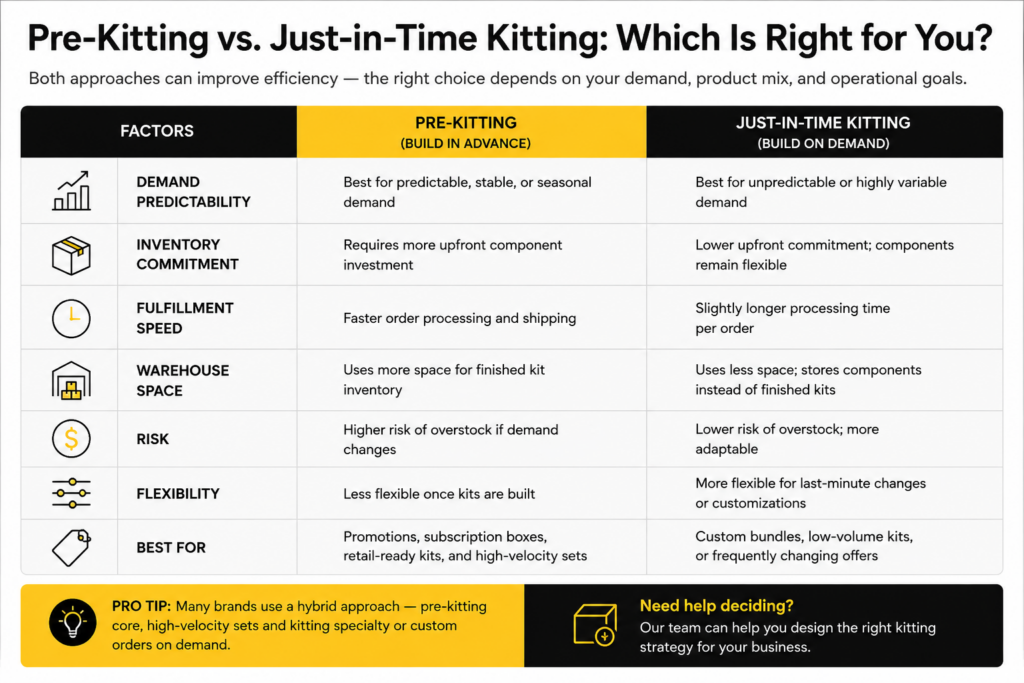
There are two main ways to manage kitting: pre-kitting and just-in-time kitting. Both can work. The right choice depends on demand, inventory, storage space, and channel requirements.
Pre-Kitting
- Subscription boxes
- Holiday gift sets
- Retail-ready kits
- Product launch kits
- High-volume bundles
- Seasonal promotions
The main advantage is speed. Once the order comes in, the kit is already built and ready to ship. The main tradeoff is inventory commitment. If you build too many kits and demand shifts, you may have finished kits sitting in storage while the individual components could have been sold separately.
Just-in-Time Kitting
Just-in-time kitting means the warehouse assembles the kit closer to the time of fulfillment.
This works well when demand is less predictable or when the same products are also sold individually.
Good use cases include:
- Flexible bundles
- Lower-volume kits
- Test campaigns
- Products with limited inventory
- Kits with changing components
- Multi-channel product sets
The main advantage is flexibility. You do not have to commit as much inventory to finished kits upfront. The tradeoff is time. Because the kit is assembled closer to shipment, the workflow may require more labor during active fulfillment. For many brands, the best strategy is a mix of both. Pre-kit predictable, high-volume sets. Use just-in-time kitting for flexible or lower-volume combinations.
Use this chart to determine if pre-kititng or just in time kitting is right for you:
How Kitting Impacts Inventory Management
Inventory accuracy is where kitting either works well or starts to break down. A finished kit may be sold as one SKU, but it is made from multiple components. Your fulfillment system needs to track both levels.
For example, say you sell a wellness kit that includes:
- 1 bottle of Product A
- 1 bottle of Product B
- 1 sample pack
- 1 printed insert
- 1 branded box
If you build 500 kits, your system should reduce the available inventory for each component and increase the available inventory for the finished kit.
If the system only tracks the finished kit, you lose visibility into the component products. If it only tracks the components, you may not know how many finished kits are ready to sell.
That can lead to:
- Overselling
- Stockouts
- Delayed orders
- Inaccurate reporting
- Replenishment issues
- Manual inventory adjustments
- Poor channel visibility
This is why kitting should be connected to your warehouse management system, ecommerce platform, marketplace listings, and inventory reporting. The stronger your inventory visibility, the easier it is to decide how many kits to build, when to replenish components, and when to adjust your sales strategy.
Kitting for Multi-Channel Fulfillment
Kitting gets more complex when you sell across multiple channels.
A kit sold on your ecommerce site may need branded packaging and an insert. The same product set sold through a marketplace may need a different SKU, label, or prep process. A retail version may need barcodes, case packs, pallet labels, or retailer-specific compliance steps.
That means your kitting process has to account for more than the products inside the box.
It also needs to account for:
- Sales channel
- Packaging rules
- Labeling requirements
- Barcode requirements
- Retailer compliance
- Marketplace prep
- Shipping method
- Case pack requirements
- Returns handling
- Inventory allocation
This is where a flexible fulfillment partner matters.
If your 3PL treats every kit like a one-off exception, your team will spend too much time managing details manually. If your 3PL has clear workflows, connected systems, and trained warehouse teams, kitting becomes much easier to scale.
Common Kitting Mistakes to Avoid
Building Too Many Kits Too Early
Pre-kitting can save time, but overbuilding can tie up inventory.
If demand is not clear, start with a smaller batch or use just-in-time kitting. Look at sales history, campaign plans, seasonality, and channel forecasts before committing too much stock.
Skipping SKU Planning
A kit needs a clear SKU structure.
Your system should know what the finished kit is, what components it includes, and how inventory should change when kits are built or sold.
Without that setup, reporting and replenishment get messy fast.
Not Tracking Packaging and Inserts
The products are only part of the kit.
Boxes, labels, inserts, samples, sleeves, tape, and other materials also need to be available. If one packaging item is missing, the entire kitting project can slow down.
Relying on Manual Instructions
If the kitting process lives in someone’s head, errors are more likely.
The warehouse team needs clear instructions, images when needed, barcode scans, quality checkpoints, and documented procedures.
Forgetting Channel Requirements
A DTC kit and retail-ready kit may look similar, but the requirements can be very different.
Before building kits, confirm the correct labels, barcodes, carton requirements, marketplace rules, and retailer instructions.
Treating Quality Control as Optional
Kitting without quality checks is risky.
The more components in a kit, the more important accuracy becomes. A missed item can create returns, refunds, reships, poor reviews, and customer service work.
Waiting Until the Last Minute
Kitting works best when there is time to plan.
If your team is building kits right before a promotion, product launch, or peak season rush, there is less time to test packaging, verify inventory, train the team, and fix issues before orders start moving.
What to Include in a Kitting Project Brief
A kitting project should not begin with a box of products and a few informal instructions.
Before work starts, the brand and warehouse need one approved project brief that defines what will be built, how it will be checked, and when it needs to be ready.
Include the following information:
Finished Kit Details
Document the finished kit name, SKU, barcode, dimensions, weight, sales channels, expected order volume, and planned launch date.
Complete Bill of Materials
List every product, packaging component, insert, label, sample, and shipping material required for one finished kit.
For each component, include:
- SKU or item number
- Required quantity
- Approved product variant
- Lot or expiration requirements
- Handling instructions
- Substitution rules
Visual Assembly Instructions
Quality Control Requirements
Define what the warehouse must verify before the finished kit is released into inventory.
Checks may include:
- Correct products and quantities
- Correct variants
- Barcode readability
- Label placement
- Package condition
- Lot or expiration compliance
- Finished weight
- Seal integrity
- Retail or marketplace requirements
Inventory Rules
Production Schedule
Exception Handling
Document what should happen when a component is damaged, missing, delayed, substituted, or unavailable.
Clear exception rules keep the warehouse from making assumptions that affect the product or customer experience.
A complete project brief gives the warehouse one controlled source of truth. That leads to cleaner pricing, faster training, more consistent assembly, and fewer corrections once production begins.
How MAI Fulfillment Supports Kitting
Frequently Asked Questions About Warehouse Kitting
Most fixed, physically assembled kits should have a finished kit SKU so the warehouse can store, count, pick, and report on them as complete units.
A temporary or virtual bundle may be managed differently. In that workflow, the customer sees one offer, but the warehouse continues picking the individual component SKUs. The right setup depends on how the bundle is sold, assembled, stored, and tracked.
Yes. De-kitting is the process of opening finished kits and returning eligible components to individual inventory.
Brands may need to de-kit products when a promotion ends, demand changes, packaging is updated, or individual components are needed for another channel. The warehouse should inspect each component before returning it to sellable inventory and update both finished-kit and component quantities in the inventory system.
Returned kits need a documented inspection process.
The warehouse should confirm whether the full kit was returned, inspect each component, and determine whether the products can be restocked as a finished kit, returned to individual inventory, repackaged, quarantined, or disposed of.
The correct workflow depends on product condition, packaging, tamper evidence, expiration dates, lot controls, and your brand’s return policy.
Yes, but the finished configurations may need separate SKUs and workflows.
A DTC version may use branded packaging and marketing inserts. A retail version may require a UPC, case packs, carton labels, shelf-ready packaging, or retailer routing requirements. A marketplace version may have its own prep, barcode, or packaging rules.
Treating every channel configuration as the same kit can create inventory errors and compliance problems. The products may be similar, but the operational requirements are not always interchangeable.