
Growth should create opportunity, not warehouse chaos.
But as ecommerce order volume increases, small operational weaknesses become much harder to ignore. A receiving delay becomes an inventory problem. A manual workaround becomes an order bottleneck. A promotion that once generated excitement starts putting pressure on your entire team.
That is why scalable ecommerce warehousing is about more than finding additional storage space.
A scalable warehouse operation can absorb more inventory, orders, sales channels and operational complexity without allowing costs, errors or delays to grow at the same rate.
Key Takeaways
Scalable ecommerce warehousing combines capacity, labor, technology and repeatable workflows.
More warehouse space does not automatically create a scalable operation.
Brands should plan for promotional spikes, seasonal demand and channel expansion, not only average order volume.
Inventory accuracy and connected systems become more important as operations grow.
A scalable 3PL should be able to adjust processes without forcing every brand into the same workflow.
MAI’s Warehouse Scalability Stress Test helps identify where growth is most likely to create operational strain.
What Is Scalable Ecommerce Warehousing?
- Storage capacity
- Receiving space
- Warehouse labor
- Picking and packing stations
- Inventory management technology
- Carrier capacity
- Kitting and assembly support
- DTC, B2B and retail workflows
Scalability Is More Than Warehouse Space
It is easy to treat warehouse capacity as a square-footage question:
Do we have enough room for more inventory?
That matters, but it is only one part of the picture.
A warehouse may have open racking and still struggle to process a sudden rise in orders. Another operation may have enough labor but lack accurate inventory data. A third may handle DTC orders well but break down when retail routing guides, wholesale case packs or custom bundles enter the workflow.
True warehouse scalability depends on several connected capabilities.
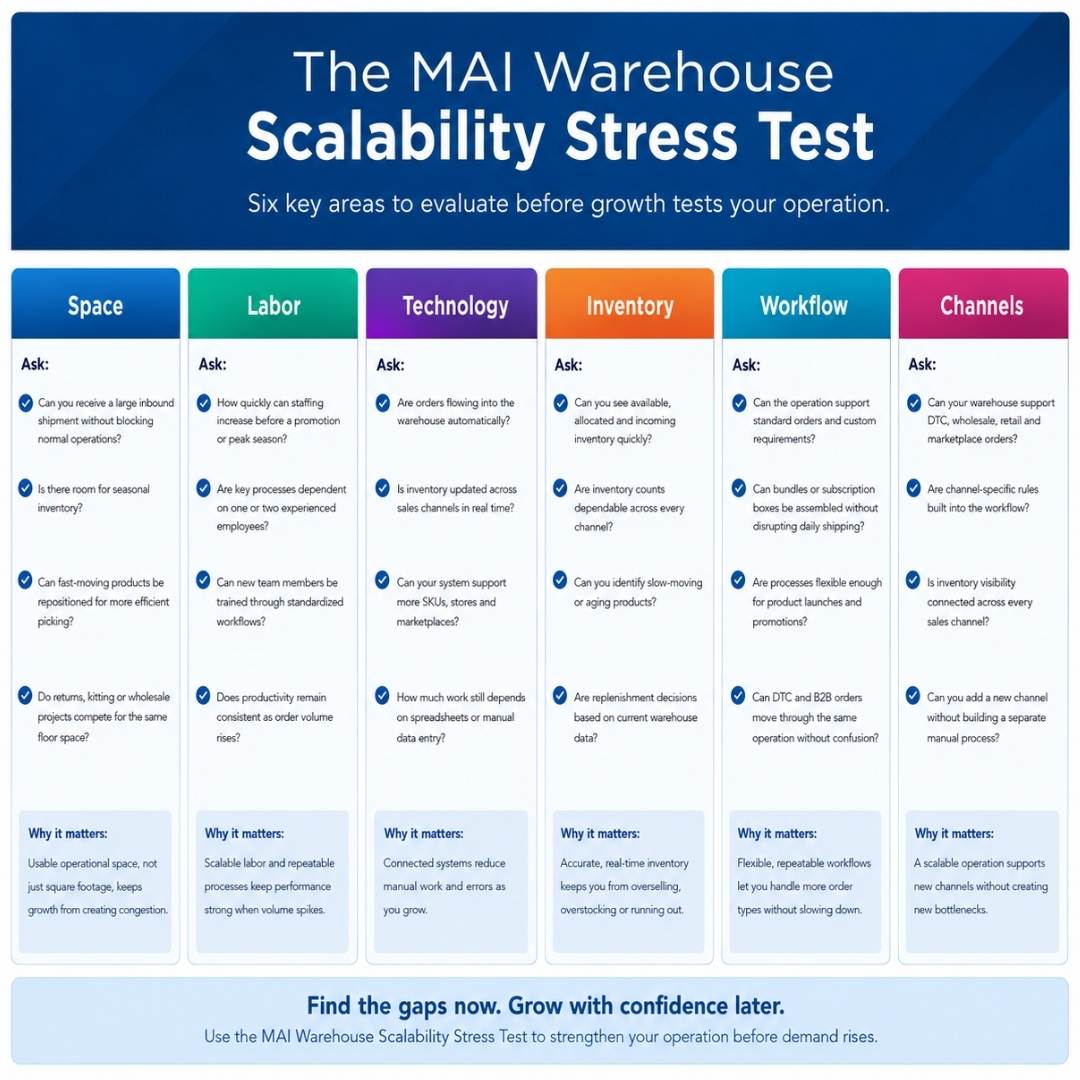
A weakness in any one of these areas can become a growth bottleneck.
Why Ecommerce Warehousing Becomes Harder as You Grow
Higher volume does not simply mean doing more of the same work.
Growth introduces new variables.
You may add products with different storage or handling requirements. A wholesale customer may require specific labels and carton configurations. A marketplace may impose strict shipping expectations. A promotion may create several days of concentrated demand instead of a predictable increase in daily orders.
As these variables stack up, your operation must manage:
- More SKUs
- More inventory locations
- More order types
- More packaging requirements
- More sales platforms
- More customer expectations
- More data moving between systems
The operation becomes more interconnected. That means one bottleneck can affect several other parts of the business.
For example, delayed receiving does not only affect warehouse organization. It can create inaccurate available-to-sell inventory, missed orders, customer service questions and poor purchasing decisions.
Scalability is what keeps these connections from becoming points of failure.
The MAI Warehouse Scalability Stress Test
Most operations work when volume is predictable.
The real question is what happens when conditions change.
Use this six-part stress test to identify where your current warehouse operation may struggle as the business grows.
1. The Space Test
Ask:
- Can you receive a large inbound shipment without blocking normal operations?
- Is there room for seasonal inventory?
- Can fast-moving products be repositioned for more efficient picking?
- Do returns, kitting or wholesale projects compete for the same floor space?
Storage capacity is important, but usable operational space matters just as much. Inventory that technically fits inside a building can still create congestion if receiving, staging and picking areas are too limited.
2. The Labor Test
Ask:
- How quickly can staffing increase before a promotion or peak season?
- Are key processes dependent on one or two experienced employees?
- Can new team members be trained through standardized workflows?
- Does productivity remain consistent as order volume rises?
A scalable operation needs more than access to additional people. It needs documented processes, appropriate supervision and systems that allow labor to be added without creating more mistakes.
3. The Technology Test
Ask:
- Are orders flowing into the warehouse automatically?
- Is inventory updated across sales channels in real time?
- Can your system support additional SKUs, stores and marketplaces?
- How much work still depends on spreadsheets or manual data entry?
Manual tasks may appear manageable at lower volumes. As order counts increase, they create delays and multiply opportunities for error.
A connected warehouse management system should make growth easier to control—not add another layer of complexity.
4. The Inventory Test
Ask:
- Can you quickly see available, allocated and incoming inventory?
- Are inventory counts dependable across every channel?
- Can you identify slow-moving or aging products?
- Are replenishment decisions based on current warehouse data?
Inventory accuracy becomes more important as the business scales. Without clear data, brands may oversell products, reorder unnecessarily or hold too much inventory in the wrong location.
5. The Workflow Test
Ask:
- Can the operation support standard orders and custom requirements?
- Can bundles or subscription boxes be assembled without disrupting daily shipping?
- Are processes flexible enough for product launches and promotions?
- Can DTC and B2B orders move through the same operation without confusion?
Scalability requires repeatable workflows, but repeatable does not have to mean rigid.
The best operations establish clear processes while preserving enough flexibility to support different products, channels and customer requirements.
6. The Channel Test
Ask:
- Can your warehouse support DTC, wholesale, retail and marketplace orders?
- Are channel-specific rules built into the workflow?
- Is inventory visibility connected across every sales channel?
- Can you add a new channel without building a separate manual process?
Channel growth often creates more operational pressure than brands expect.
Shipping ten percent more DTC orders may be relatively straightforward. Adding a national retail customer with routing guides, pallet requirements and scheduled delivery windows is a different kind of growth.
A scalable warehouse must be prepared for both.
Warning Signs Your Warehouse Is Not Scaling
You do not need a major service failure to know that the operation is under pressure.
Scalability problems usually appear gradually.
Watch for these warning signs:
- Orders regularly take longer to ship during promotions.
- Inventory counts become harder to confirm.
- Receiving delays affect available-to-sell inventory.
- Warehouse employees rely on undocumented workarounds.
- Customer service spends more time investigating order status.
- New SKUs create slotting and storage problems.
- Kitting projects interfere with normal order fulfillment.
- Wholesale orders create bottlenecks for DTC shipping.
- Your team cannot produce reliable operational reports quickly.
- Growth requires adding administrative work at nearly the same rate as order volume.
One isolated issue may be fixable. Several of these issues appearing together usually indicate that the operation needs structural changes.
How to Make Ecommerce Warehousing More Scalable
Scalability does not come from a single warehouse improvement. It comes from strengthening the entire operating model.
Build Around Demand Ranges
Planning only for average daily volume can leave the operation exposed.
Instead, define several demand scenarios:
- Standard weekly volume
- Promotional volume
- Peak-season volume
- New-product-launch volume
- Wholesale or retail rollout volume
For each scenario, estimate the inventory, labor, stations, packaging materials and carrier capacity required.
This turns scalability from a vague goal into a capacity plan.
Standardize Core Processes
Receiving, putaway, picking, packing, cycle counting and returns should follow documented workflows.
Standardization makes it easier to:
- Train employees
- Measure performance
- Find bottlenecks
- Maintain consistency
- Add labor during busy periods
The goal is not to eliminate flexibility. It is to create a dependable foundation that can support it.
Connect Orders and Inventory
Disconnected systems create duplicate work and delayed information.
Your ecommerce platform, marketplaces, order management tools and warehouse management system should exchange information automatically whenever possible.
Connected technology helps your team maintain:
- Current inventory availability
- Accurate order status
- Consistent SKU data
- Faster exception management
- Better forecasting information
The more channels you add, the more important this connectivity becomes.
Improve Inventory Slotting
Not every SKU should be stored or picked in the same way.
Fast-moving products should generally be positioned for efficient access, while slower-moving inventory may be placed in less active storage areas. Product dimensions, order frequency, bundle relationships and handling requirements should all influence slotting decisions.
As product demand changes, slotting should change with it.
Create Flexible Labor Plans
Peak volume should not come as a surprise to the warehouse.
Use historical order patterns, promotional calendars, inbound schedules and sales forecasts to determine when additional labor may be required.
Cross-training is also important. Employees who can move between receiving, picking, packing and value-added projects give the operation more options when priorities shift.
Measure Capacity Before It Becomes a Problem
Warehouse reporting should show more than the number of orders shipped.
Useful scalability metrics may include:
- Orders processed per labor hour
- Receiving turnaround time
- Dock-to-stock time
- Order cycle time
- Inventory accuracy
- Picking accuracy
- Space utilization
- Orders shipped by cutoff
- Backlog volume
- Cost per order
- Return processing time
Tracking these metrics over time helps you see whether growth is creating efficiency or eroding it.
Plan for Surges, Not Just Steady Growth
Ecommerce demand rarely moves in a straight line.
A successful campaign, influencer mention, retail launch or seasonal event can produce a sudden surge. The operation may need to handle several times its normal daily order count with limited notice.
A scalable warehouse prepares for this before orders arrive.
That preparation may include:
- Forecasting expected order volume.
- Receiving promotional inventory early.
- Pre-assembling bundles or kits.
- Confirming packaging material levels.
- Adjusting product slotting.
- Scheduling additional labor.
- Reviewing carrier pickups and cutoff times.
- Establishing an exception-management process.
This is where warehouse capacity planning directly affects customer experience. The promotion is not successful when orders are placed. It is successful when those orders are shipped accurately and on time.
How Omnichannel Growth Changes Warehouse Requirements
Many established ecommerce brands are no longer operating through one online store.
They may fulfill:
- Website orders
- Marketplace orders
- Subscription shipments
- Wholesale cases
- Retail replenishment orders
- Promotional kits
- Amazon preparation orders
Each order type can have different inventory, packaging, labeling and shipping requirements.
A scalable omnichannel warehouse must keep these workflows connected without treating every order as identical.
For example, DTC fulfillment may prioritize individual order speed and branded packaging. A retail order may require carton labels, packing lists, routing compliance and delivery appointments. Both may pull from the same inventory, but they cannot always follow the same process.
Your operation needs enough structure to maintain accuracy and enough flexibility to support the requirements of each channel.
Should You Scale In-House or Work With a 3PL?
The answer depends on your existing capabilities, growth plans and appetite for operational investment.
Scaling an in-house warehouse may require:
- Additional real estate
- Warehouse management technology
- Recruiting and training
- Equipment
- Insurance and compliance
- Carrier relationships
- Management expertise
- Peak-season labor planning
For some brands, maintaining direct control over these resources makes sense.
For others, working with a third-party logistics provider offers access to shared infrastructure, established technology and operational expertise without building every capability internally.
The decision should not be based only on current order volume.
Consider what the business may require over the next 12 to 24 months:
- Will you launch new products?
- Will you add wholesale or retail?
- Will you enter new marketplaces?
- Will inventory requirements change?
- Will order volume become more seasonal?
- Will customer delivery expectations increase?
Choose the model that can support where the business is going, not only where it is today.
What to Look for in a Scalable Warehousing Partner
Not every large warehouse offers scalable ecommerce fulfillment.
When evaluating a provider, ask how the operation handles real-world changes.
Capacity and Labor
- How do you prepare for seasonal peaks?
- How is labor allocated when client volume changes?
- What happens when inbound and outbound volume rise at the same time?
Technology
- Which ecommerce and business systems can you integrate with?
- How quickly does inventory update?
- Can workflows and reporting be configured around our requirements?
Operational Flexibility
- Can you support DTC and B2B fulfillment?
- Can you manage bundles, subscription orders or retailer-specific requirements?
- How are nonstandard projects scheduled?
Visibility and Support
- Which reports will we have access to?
- Who will answer operational questions?
- Is support connected directly to the warehouse team?
Performance
- Which service levels are documented?
- How are accuracy and shipping performance measured?
- How are exceptions communicated and resolved?
A scalable partner should be able to answer these questions specifically. “We can handle growth” is not enough without systems and processes behind the claim.
How MAI Approaches Scalable Ecommerce Warehousing
At MAI Fulfillment, scalability is built around connected technology, flexible workflows and real people who understand what is happening inside the warehouse.
Our approach helps established and scaling brands manage changing requirements across DTC, B2B and omnichannel fulfillment.
That includes:
- Technology integrations that keep order and inventory data connected
- Real-time operational visibility
- Flexible workflows for different products and order types
- Kitting, bundling and value-added services
- Support from a consistent point of contact
- Warehouse teams that are part of MAI—not outsourced labor operating under another provider
- Capacity planning for promotions, product launches and seasonal volume
The objective is not simply to store more inventory or ship more boxes.
It is to give your operation room to change without losing the control, accuracy and responsiveness your brand depends on.
Frequently Asked Questions
What does scalability mean in ecommerce warehousing?
Scalability means a warehouse operation can adjust its space, labor, technology and processes as inventory, order volume and channel complexity change. Growth can be supported without a proportional increase in delays, errors or manual work.
Why is warehouse scalability important for ecommerce?
Ecommerce demand can change quickly. A scalable warehouse helps brands manage promotions, peak seasons, product launches and channel expansion while maintaining consistent fulfillment performance.
Is a larger warehouse automatically more scalable?
No. A large building may provide storage capacity, but scalability also depends on labor, workflows, inventory accuracy, technology, carrier access and the ability to support different order types.
How can a warehouse prepare for peak order volume?
Preparation should include volume forecasting, early inventory receiving, labor planning, product slotting, packaging-material planning, carrier coordination and clearly defined escalation procedures.
When should an ecommerce business consider a 3PL?
A business may consider a 3PL when warehouse space, staffing, technology or operational complexity begins limiting growth. It is often better to evaluate potential partners before service problems become urgent.
Can one warehouse support both DTC and B2B fulfillment?
Yes, but the operation needs workflows that account for the different requirements. DTC orders typically involve individual parcels, while B2B and retail orders may require case packing, palletization, labels, routing guides and scheduled deliveries.
Build Capacity Before Growth Tests It
Warehouse problems are easier to solve before your busiest sales period, next channel launch or largest inbound shipment.
The right time to evaluate scalability is not when orders are already late. It is when your team can still examine capacity, improve systems and build a plan without reacting under pressure.
Scalable ecommerce warehousing gives your brand more than extra room. It gives you the operational confidence to pursue growth knowing your fulfillment infrastructure is ready to support it.
Is your current warehouse ready for what comes next? Talk with MAI Fulfillment about scalable warehousing and fulfillment built around your products, channels and growth plans