It usually starts the same way. You launch DTC and things feel controlled, with steady, predictable orders moving cleanly through pick, pack, and ship workflows. Then wholesale starts to grow, retailers place larger orders, and before long your warehouse is handling single-unit shipments and pallet-level orders at the same time, all inside the same operation.
At first, it feels manageable, but over time the cracks start to show as orders slow down, inventory stops lining up across channels, and your team ends up spending more time fixing issues than moving product.
DTC and B2B fulfillment are not just different lanes of the same road, they operate on completely different rules and treating them the same is what ultimately creates operational drag.
Key Takeaways About DTC vs B2B Fulfillment Requirments
DTC fulfillment depends on speed and accuracy
High order volume and customer expectations require fast processing, real-time inventory, and error-free execution.
B2B fulfillment requires compliance and coordination
Retail orders demand strict adherence to routing guides, labeling rules, and delivery windows to avoid chargebacks and delays.
Shared workflows create operational bottlenecks
Running DTC and B2B through the same process leads to slower orders, missed requirements, and inconsistent inventory allocation.
Separate workflows improve performance across channels
Distinct processes, aligned inventory, and clear prioritization keep both DTC and B2B orders moving on time.
Integrated systems enable real-time control
DTC vs B2B Fulfillment
DTC fulfillment focuses on high-volume, fast, direct-to-customer orders, while B2B fulfillment centers on bulk shipments with strict compliance requirements. Each model requires different workflows, systems, and operational priorities to perform effectively.
DTC fulfillment is a speed and accuracy game
DTC Fulfillment is built around volume and speed, where you are shipping individual orders directly to customers who expect fast delivery and zero mistakes, leaving very little margin for error.
Common DTC fulfillment failure points that impact speed and accuracy
- Orders pile up during peak periods
- Inventory falls out of sync across sales channels
- Picking errors increase as order volume climbs
The impact shows up immediately, as late deliveries turn into support tickets, incorrect orders turn into returns, and every mistake chips away at the customer experience you worked to build.
Proven steps to improve DTC fulfillment performance and throughput
- Use real-time inventory visibility across every channel
- Optimize pick and pack workflows for higher throughput
- Align carrier routing with delivery expectations and daily cutoffs
- Automate order ingestion to remove manual entry
When DTC fulfillment is set up correctly, orders move predictably even as volume increases, inventory stays aligned across every channel, and your team can focus on throughput instead of fixing mistakes. That consistency is what protects both your margins and your customer experience as you scale.
B2B Fulfillment Runs on Compliance and Consistency
B2B Fulfillment runs on a different set of expectations. Orders are larger, requirements are stricter, and every shipment is tied to retailer rules that leave very little room for error.
When things go wrong, it usually shows up as missed routing guide requirements, incorrect labels, or shipments that get rejected at receiving. That does not just slow things down. It leads to chargebacks, delayed payments, and strained relationships with retail partners.
The fix is not complicated, but it must be consistent. You need workflows built around compliance, standardized labeling and documentation, systems that support EDI, and outbound planning that aligns with delivery windows instead of warehouse convenience.
When those pieces are in place, B2B orders move predictably, and you avoid the penalties that eat into margin.
Trying to Run DTC and B2B on the Same Workflow Creates Bottlenecks
This is where most brands hit friction, when growth forces DTC and B2B orders into the same workflows, systems, and processes without any real separation.
At first, it seems efficient to run everything through one path, but that approach does not hold up under pressure. As order volume increases and requirements diverge, the cracks start to show in how orders are prioritized, processed, and fulfilled across both channels.
Operational risks when DTC and B2B fulfillment share the same workflow
- DTC orders slow down when B2B orders take priority
- B2B orders get rushed and miss compliance steps
- Inventory allocation becomes inconsistent across channels
Now you are not just inefficient. You are creating risk on both sides of the business.
Proven ways to separate DTC and B2B workflows without slowing operations
- Separate workflows for DTC and B2B operations
- Allocate inventory based on channel demand and forecasting
- Use systems that can support both order types without conflict
- Build rules that prioritize orders based on deadlines and SLAs
The result is DTC and B2B need separate workflows, clear inventory allocation, and systems that can support both without conflict. When those pieces are in place, orders move on the right timelines, requirements are met consistently, and you avoid the tradeoffs that slow one side down to support the other.
Why most 3PLs struggle to support both DTC and B2B fulfillment
Most 3PLs are built with a clear bias. They are either optimized for DTC speed or designed around B2B compliance, and that gap shows up quickly when you try to scale across both.
DTC-focused providers often struggle with the structure and requirements of B2B orders, while B2B-focused providers lack the speed and flexibility needed for high-volume DTC fulfillment. The result is usually a split operation, where inventory is fragmented and coordination becomes a daily challenge.
To avoid that, you need a partner that can support both models without forcing you to separate inventory or workflows across multiple providers. When everything runs under one system, you maintain visibility, reduce complexity, and keep costs under control.
Integrated Systems Are What Keep Both Models in Sync
Execution matters, but coordination is what keeps everything from breaking under pressure. When your systems are not connected, even small delays start to compound. Inventory lags across channels, orders require manual fixes, and your team ends up reconciling data instead of moving orders forward. What should be a smooth flow turns into constant correction.
This is where most operations lose control. You are not short on effort, but the systems are not giving you a clear, real-time picture of what is happening across DTC and B2B.
The fix is simple in concept but critical in practice. Your systems need to be integrated so orders flow in automatically, inventory updates in real time across every channel, and data moves without manual intervention between platforms.
When that is in place, everything starts to tighten up. Orders move faster because they are not waiting on manual input. Inventory stays accurate because updates are immediate. Reporting becomes something you can act on in real time instead of something you review after the fact. That is when you shift from reacting to problems to operating with control.
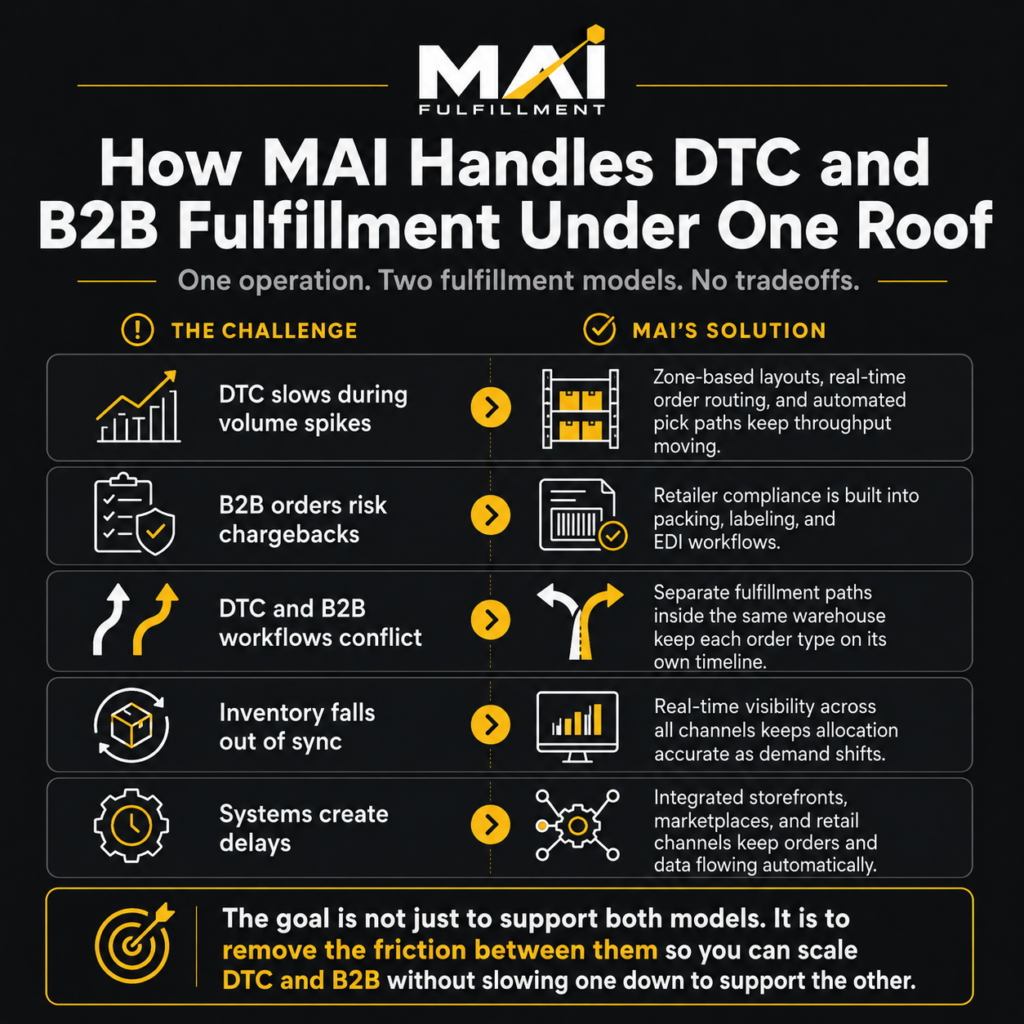
How MAI Handles DTC and B2B Fulfillment Under One Roof
Everything above comes down to one thing. You need an operation that can run two different fulfillment models without forcing tradeoffs. We build that by tying execution back to the exact failure points you see when DTC and B2B are handled the same way.
- When DTC slows down under volume, we use zone-based layouts, real-time order routing, and automated pick paths to keep throughput consistent during spikes
- When B2B orders risk chargebacks, we embed retailer compliance into packing, labeling, and EDI workflows so requirements are met every time
- When workflows conflict, we separate DTC and B2B paths inside the same warehouse, so each order type moves on its own timeline
- When inventory falls out of sync, we maintain real-time visibility across all channels, so allocation stays accurate as demand shifts
- When systems create delays, we integrate storefronts, marketplaces, and retail channels so orders and data flow without manual intervention
The goal is not just to support both models. It is to remove the friction between them. That is what allows you to scale across DTC and B2B without slowing one down to support the other.
DTC and B2B fulfillment are built on different requirements, and the gap between them shows up quickly once you try to run both inside the same operation. DTC depends on speed, accuracy, and high-volume throughput, while B2B depends on compliance, coordination, and meeting strict retailer expectations. When those differences are ignored, the result is predictable. Orders slow down, errors increase, and inventory falls out of sync.
The brands that scale well do not try to force both models through the same process. They separate workflows, align inventory with channel demand, and use systems that keep everything connected in real time. That is what keeps DTC moving fast while B2B stays compliant.
When those pieces are in place, fulfillment stops being a source of friction and starts becoming a growth driver. You maintain control, protect margins, and support both channels without one dragging down the other.