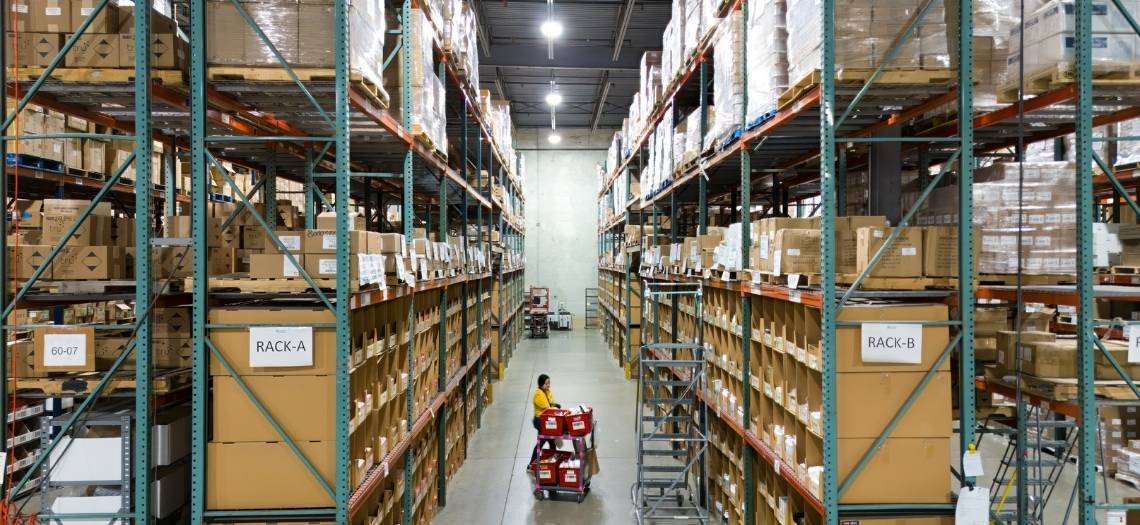

On its busiest days, Amazon fulfills millions of orders to customers located in all corners of the globe. Although Amazon’s founder, Jeff Bezos, doesn’t meet these customers face-to-face, the company has figured out how to achieve high marks for customer satisfaction through its well-planned order fulfillment techniques.
Even if you are not as big as Amazon, your business still needs to have a pulse of some Key Performance Indicators (KPIs) or metrics to know how it weights in on the customer satisfaction scale. Here are six fulfillment metrics every business needs to track to measure customer satisfaction in definite terms:
- Fulfillment Accuracy Rate
- Inventory Accuracy
- Rate of Return
- Order Processing Speed
- Order Tracking Availability
- Transportation Cost Per Package
Fulfillment Accuracy Rate
How it’s measured: Total number of accurately filled orders divided by the total number of orders shipped during a particular period.
Ideally, the fulfillment accuracy rate will be 100%. You must fulfill every single order that your customer places. However, errors creep in in the form of mislabelled SKUs, picking the wrong SKU from product lines, packing wrong quantities, stockouts, etc. When such errors happen, the fulfillment accuracy rate drops.
Every order fulfilled incorrectly increases the risk of customer dissatisfaction. No one likes receiving items they did not order, items that are the wrong size or color, or not receiving their order on time due to the seller’s mistake. Hence, the need to monitor fulfillment accuracy rates regularly is critical – and, the higher the order volumes, the higher the need for frequent monitoring.
There are a number of things that can initiate a customer return. Some of these are ‘quality control’ related, while others are specific to the customer. With regard to ‘quality control’ related items, the most common returns are a result of either mis-shipments or defective products. In the case of a mis-shipment, the return results from the fulfillment department (or fulfillment services company if you outsource) sending out the wrong product. In cases of defective products, either the entire product is defective or a part of the product isn’t working properly, each of which might result in a different course of action for the returns process.
When it comes to the customer, there are a number of ways in which a return can be initiated. First, the product may not fit – requiring another size, etc. Second, the customer may determine that the product didn’t meet their needs. Third, the customer may decide that he or she doesn’t actually want it. Finally, there may not be a reason at all – they just may simply wish to return it.
Inventory Accuracy
How it’s measured: By tallying the physical count of inventory available with the count of inventory as recorded in accounting ledgers.
Accurate inventory counts help ensure orders are processed without delays and errors. Inventory accuracy also reduces the possibility of stockouts. Stockouts and inaccurate inventory count can lead to back orders – orders that are raised by customers seeing that the stock is available online in the store but in reality, they are out of stock at the warehouse.
The takeaway: maintaining inventory accuracy helps in maintaining high fulfillment rates which translates into higher levels of customer satisfaction.
Rate of Return
How it’s measured: Total number of returned orders divided by total number of fulfilled orders.
Almost one third of web retail orders are returned – and processing those returns is costly, especially if orders were initially shipped for free. Gaining insight into why customers return orders can potentially help lower the rate of return as well as ensure higher levels of customer satisfaction.
- Was the order processed correctly?
- Is something wrong with the packaging?
- Did the products arrive broken or go missing during transit?
- Was the delivery schedule too long?
- Are customers unhappy with the quality of the merchandise (i.e., is it accurately represented online or in the catalog)?
Uncovering and addressing these issues will help reduce the rate of return and save money while boosting customer satisfaction.
Order Processing Speed
How it’s measured: The average time taken from receiving an order to processing it for dispatch.
The time taken to complete an order from receipt until delivery is referred to as the order processing speed. The order processing speed and customer satisfaction have a direct relationship. The quicker the order processing, the higher the customer satisfaction.
The surge of on-demand economy and same-day deliveries is proof that customer satisfaction is heightened with quick order processing. A business cannot predict how quickly it can ship and deliver the product at customer doorstep. However, it can perfect its side of processing the order as quickly as possible to shorten the delivery span.
Order Tracking Availability
How it’s measured: Order tracking is more of a capability than a metric. You cannot put a number and measure it.
GPS-based order tracking that gives real-time visibility of delivery progress can make an eager customer feel more relaxed and at ease. Push notifications, custom delivery statuses, contact info of logistic partner and the assigned delivery personnel – all make the customer feel like they have control over the delivery process.
A customer who feels he or she is in control is a customer who will remain loyal to your business. Hence, the inevitable need to provide order tracking capabilities to your customers.
Transportation Cost Per Package
How it’s measured: Total transportation cost during a period divided by total number of completed deliveries during the period.
Also known as shipping cost per order, this metric helps identify how much money your business spends to deliver each package to the customer.
Keeping the transportation cost per package as low as possible is vital to business profitability. Lower transportation costs lead to cost savings, which can again be transferred to customers in the form of lower priced goods.
If your business has the practice of charging shipping costs for specific items, a lower transportation cost is indeed an excellent way to delight customers.
These are the six key metrics that you can bank on to know where you stand in terms of delivering customer satisfaction. As described above, some fulfillment metrics need to weigh more, while others need to be maintained as low as possible. Measure them, track them and act upon the results to become a business that is truly customer-centric.
To know more about MAI’s expertise in contact center and fulfillment services, please contact us today!
If your current 3PL is creating more problems than it solves, MAI Fulfillment can help you build a fulfillment operation that supports growth with more accuracy, visibility, and control.