
A low pick and pack rate can make a 3PL proposal look attractive. But that one number does not tell you what fulfillment will actually cost.
Your total cost may also include receiving, storage, packaging, additional picks, shipping, carrier surcharges, returns, technology and special projects. Some of these are standard operating expenses. Others become a problem when they are unclear, difficult to forecast or buried across multiple rate sheets.
The goal is not to find the 3PL with the fewest line items. It is to understand what each service costs, when additional charges apply and how the full model affects your cost per order.
Key Takeaways
Look beyond the pick and pack rate
. Receiving, storage, packaging, shipping, returns, technology and monthly minimums all contribute to your actual fulfillment cost.
Use your real order profile
Product dimensions, units per order, SKU count, destinations, channel mix and seasonality can change pricing significantly.
Review shipping separately
Carrier surcharges, dimensional weight and any provider markup can make an inexpensive warehouse rate more costly once the order ships.
Compare total cost per shipped order
The strongest pricing model is not necessarily the one with the lowest line item. It is the one you can clearly understand, forecast and connect to reliable performance.
What to Know Before Comparing 3PL Pricing
The advertised handling rate is only one part of the cost. A low pick fee can be offset by higher shipping costs, packaging charges or monthly minimums.
Your order profile matters more than volume alone. Product dimensions, units per order, SKU count, destinations and channel requirements all affect pricing.
Shipping needs to be reviewed separately. Carrier base rates, fuel, residential delivery, delivery-area charges and dimensional weight can materially change the final shipment cost.
The best pricing model is one you can verify and forecast. You should be able to estimate costs during a typical month, a slower period and peak season.
How Is 3PL Pricing Structured?
3PL pricing is the amount a business pays a third-party logistics provider to receive inventory, store products, process orders and coordinate shipping.
Some providers bundle multiple activities into one rate. Others price each activity separately.
Neither approach is automatically better. Bundled pricing may be easier to forecast, but only when the included services are clearly defined. Itemized pricing provides more detail, but it can make the total harder to calculate.
A useful proposal should explain the billing unit, what is included and what can trigger an additional charge.
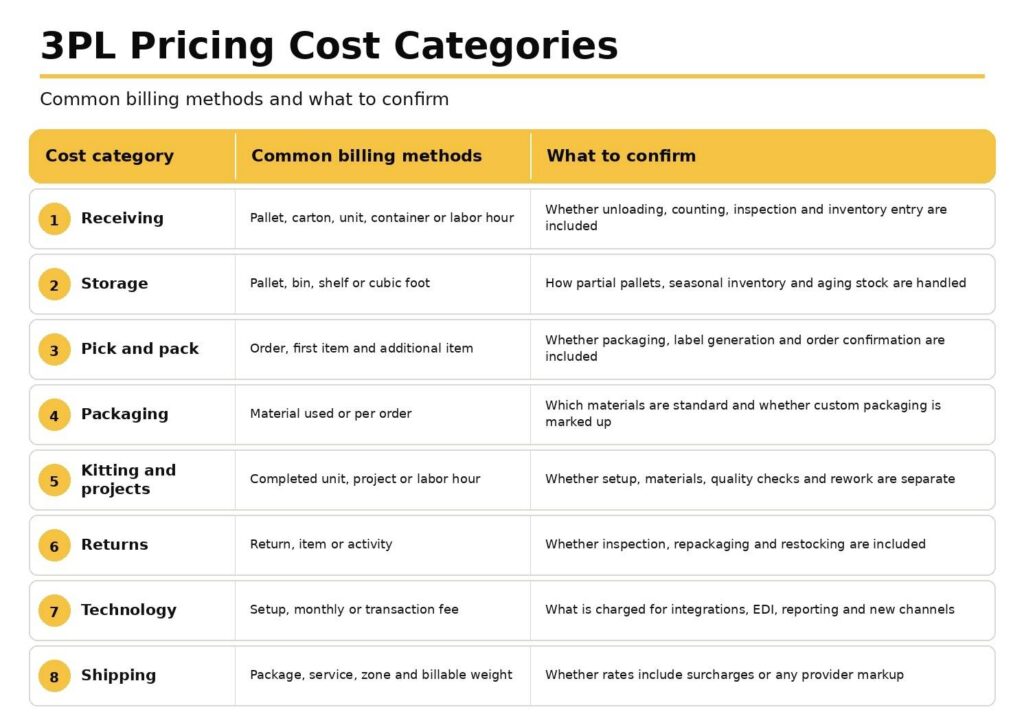
The fee itself is not necessarily the issue. The issue is whether you know what you are receiving for it.
What Changes Your Actual Fulfillment Cost?
Two brands can ship the same number of monthly orders and still have very different costs.
A brand shipping one small product per order creates a different warehouse workflow than a brand shipping fragile items, multi-SKU bundles, subscription kits and retail pallets.
Your Order Profile
Average units per order affects the number of picks required. A large SKU catalog can require more storage locations and inventory controls. Branded inserts, gift notes, lot tracking and quality checks can add steps to the packing process.
That is why a quote based only on monthly order volume is rarely enough.
The provider should also understand your units per order, active SKU count, product dimensions, packaging requirements, return activity and peak volume.
Your Product and Packaging
Product size affects storage and transportation.
Large, lightweight products can be particularly expensive because carriers may charge according to dimensional weight instead of scale weight. The box can therefore affect the shipping charge as much as the product itself.
Packaging that is too large may increase billable weight. Packaging that is too small or poorly designed can create damage, repacking and replacement costs.
The right packaging decision balances material cost, labor, product protection and shipping efficiency.
Your Sales Channels
DTC, wholesale and retail orders should not be priced as the same activity.
A DTC order may require individual picking, parcel packaging and a shipping label. A retail order may require case packing, pallet labels, routing guide compliance, EDI documents and a delivery appointment.
This article is focused on pricing rather than the operational differences between channels. The important pricing question is whether every order type has been defined before the agreement begins.
Your Seasonality
Annual averages can hide expensive months.
A monthly minimum that is easy to meet during peak season may create unnecessary cost during a slower period. Higher inventory levels can also increase storage costs before a seasonal promotion begins.
Model pricing against your slowest month, a normal month and your highest expected volume. That will give you a more realistic view than one annual order estimate.
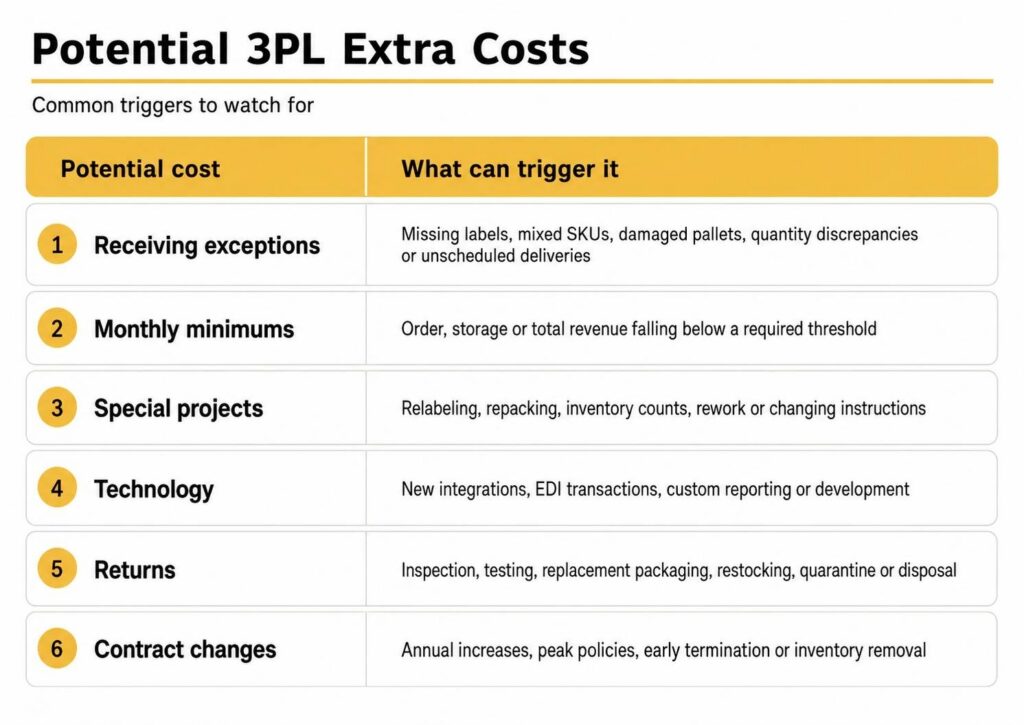
Where Hidden 3PL Fees Usually Appear
A hidden fee is not simply a charge you would prefer not to pay.
It is a fee that was not clearly disclosed, defined or included in your financial model.
The following areas deserve closer review:
Why Shipping Costs Need a Separate Review
Shipping is not one rate.
The final transportation charge may include the carrier’s base rate, fuel, residential delivery, delivery-area fees, dimensional weight, additional handling and seasonal adjustments. A 3PL may also apply its own markup or rebate structure.
Do not rely on a general claim that rates are “discounted.” Ask how the final charge is calculated and which components can change.
Fuel Surcharges Move
Fuel is not a fixed percentage that can be added to a pricing model once and forgotten.
UPS states that its U.S. ground fuel surcharge is index-based, adjusted weekly and subject to changes in percentages and thresholds.
That means an estimate based on an older fuel percentage may not match the invoice when the order ships.
Your provider should be able to explain which carrier table is used, how often the percentage changes and whether fuel is calculated before or after any provider markup.
Residential and Geographic Charges Add Up
Parcel carriers may apply additional charges based on the destination.
UPS, for example, publishes separate residential, delivery-area, extended-area and remote-area charges. The carrier also announced increases to several area and residential surcharges effective July 6, 2026.
These charges matter because ecommerce brands frequently ship to residential addresses. A lightweight package sent to a rural or extended area may have a very different cost than the same package sent to a nearby commercial address.
Ask for representative rates across the ZIP codes and zones where your customers are located.
Dimensional Weight Changes the Billable Weight
Carriers may charge according to dimensional weight when a package occupies more space than its actual weight would suggest.
FedEx explains that a shipment is charged according to its actual or dimensional weight, whichever is greater.
USPS currently instructs shippers to multiply package length, width and height and divide the result by 139 for applicable packages larger than one cubic foot. Measurements are rounded up, and the dimensional weight applies when it exceeds the actual package weight.
For example, a box measuring 16 by 12 by 10 inches has a volume of 1,920 cubic inches. Dividing by 139 produces a dimensional weight of approximately 13.8 pounds, which rounds up to 14 pounds.
If the product inside weighs only five pounds, the shipment may still be billed at 14 pounds under the applicable dimensional-weight rules.
This is why packaging optimization belongs in the pricing conversation.
How to Calculate Your Total Cost per Order
1. Calculate Warehouse and Fulfillment Costs
Include receiving, storage, pick and pack, packaging, kitting, returns, technology and monthly minimums.
Use this formula:
Total monthly warehouse and fulfillment charges ÷ total orders shipped = average fulfillment cost per order
2. Calculate Transportation Separately
Include base shipping charges and all applicable carrier or provider surcharges.
Use this formula:
Total transportation charges ÷ total packages shipped = average shipping cost per package
Keeping transportation separate shows whether a proposal is inexpensive inside the warehouse but expensive once the order ships.
3. Calculate the Combined Cost
Average fulfillment cost per order + average shipping cost per package = average total cost per shipped order
Run the calculation for more than one period. Compare a typical month, your slowest month and a high-volume month.
You should also test representative order types, especially when your products vary significantly in size, units per order or channel requirements.
How to Evaluate a 3PL Quote
A useful quote should help you understand how your actual business will be billed.
Start with these six questions:
- What is included in the standard pick and pack rate?
- What triggers an additional handling or project fee?
- How are shipping rates, carrier surcharges and provider markups structured?
- How are monthly minimums calculated?
- How does pricing change for wholesale, retail, kitting and returns?
- What contract terms allow rates to increase?
Price and Performance Belong in the Same Conversation
Why Total Per Shipment Cost Is What Actually Impacts Margin
The lowest rate does not always protect your margin.
Slow receiving can leave inventory unavailable for sale. Fulfillment errors can create replacement orders, expedited shipping and refunds. Weak inventory controls can lead to stock discrepancies and unnecessary purchasing.
These costs may not appear on the 3PL invoice, but they still affect the economics of the relationship.
Pricing should therefore be evaluated alongside receiving timelines, inventory accuracy, order accuracy, shipping cutoffs and issue resolution.
You are not only buying warehouse labor. You are relying on an operation that directly affects your inventory, customer experience and ability to grow.
MAI’s Approach to Transparent 3PL Pricing
At MAI Fulfillment, we build customized pricing around the complete operation, including DTC and B2B fulfillment, warehousing, implementation, receiving, pick and pack, kitting and custom projects.
The goal is to give you a clearer view of your total fulfillment costs before inventory reaches the warehouse.
We look at your products, order profile, channel mix, shipping activity and growth plans so the pricing reflects how your business actually operates.
That means focusing on more than an attractive handling rate. It means building a model you can understand, forecast and use to make better decisions.
The Bottom Line on 3PL Pricing
Do not choose a fulfillment partner based on the lowest pick fee.
Choose the pricing model that gives you the clearest view of your total cost per order.
You should know what the standard services include, what triggers additional charges, how shipping is calculated and how the numbers change during slower and peak periods.
When that information is clear, fulfillment becomes easier to plan.
When it is not, small fees and inefficient workflows can quietly work against your margin.
Get 3PL Pricing Built Around Your Operation
Your fulfillment quote should reflect your real products, customers, order types and growth plans.
Get customized pricing from MAI Fulfillment and see what your complete fulfillment model could look like.
Frequently Asked Questions About 3PL Pricing
Do not rely only on an annual order estimate. Monthly and seasonal data shows how your operation actually behaves.
The goal is not simply to receive the lowest quote. It is to receive a proposal that reflects your real products, customers, channels, and growth plans.
How much does a 3PL cost per order?
What does a pick and pack fee include?
It may include picking the first item, packing the order, printing the shipping label and confirming shipment. Additional units, packaging materials, inserts and custom steps may be charged separately. Request a written definition..
What are common hidden 3PL fees?
Are shipping costs included in 3PL pricing?
How should I compare two 3PL quotes?
Apply both pricing models to the same order, inventory and shipping data. Calculate fulfillment and transportation separately, then combine them into an average total cost per shipped order.