Your product weighs 4 pounds. Your shipping invoice says you’re paying for 12.
The difference may have nothing to do with the product itself. It could be the box you shipped it in.
For ecommerce brands, shipping costs are not determined by weight alone. Carriers also consider how much space a package takes up, and that calculation can turn a lightweight order into a surprisingly expensive shipment.
That’s where the DIM divisor comes in.
Understanding how dimensional weight works gives you more control over packaging decisions, carrier costs, and shipping margins. And when you’re processing hundreds or thousands of orders, even small improvements can make a meaningful difference.
Key Takeaways
What Is Dimensional Weight?
Dimensional weight measures how much space a package occupies relative to its actual weight. Carriers generally use the higher of the two to calculate shipping charges.
Why the DIM Divisor Matters
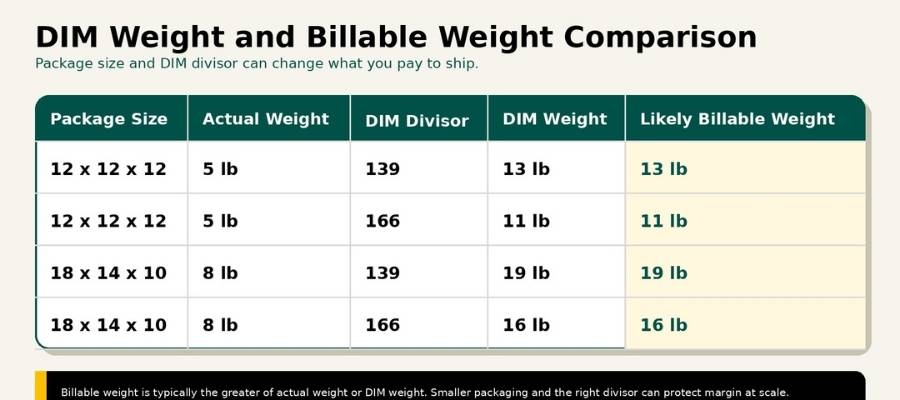
A lower DIM divisor increases dimensional weight for the same package, which can lead to higher shipping costs..
How Carrier Rules Differ
UPS, FedEx, and USPS apply different dimensional weight policies depending on the shipping service and rate structure.
How Packaging Impacts Profitability
Oversized cartons, excess void fill, and inconsistent box selection can increase billable weight and cut into margins.
How Fulfillment Processes Help Control Costs
Reviewing package dimensions, shipping data, and carton selection can uncover savings opportunities without compromising product protection.
What Is a DIM Divisor in Shipping?
A DIM divisor, also called a dimensional weight divisor or DIM factor, is the number carriers use to convert a package’s volume into a dimensional weight.
Carriers have limited space in trucks, trailers, and aircraft. A large, lightweight package can take up just as much room as a much heavier shipment. Dimensional weight pricing accounts for that space.
The basic dimensional weight formula is straightforward.
DIMENSIONAL WEIGHT FORMULA
\[ \text{DIM weight}=\frac{L\times W\times H}{\text{DIM divisor}} \]
Length, width, and height are measured in inches for U.S. pound-based calculations.
The result is compared against the package’s actual weight. For shipping services that use dimensional weight pricing, the higher number generally determines the billable weight, subject to carrier-specific rules.
For example, a package that physically weighs 5 pounds may have a dimensional weight of 13 pounds. If DIM weight applies, the carrier can charge based on 13 pounds instead of 5.
That difference matters because your shipping expense is being driven by the package’s size, not just what’s inside it.
How to Calculate DIM Weight
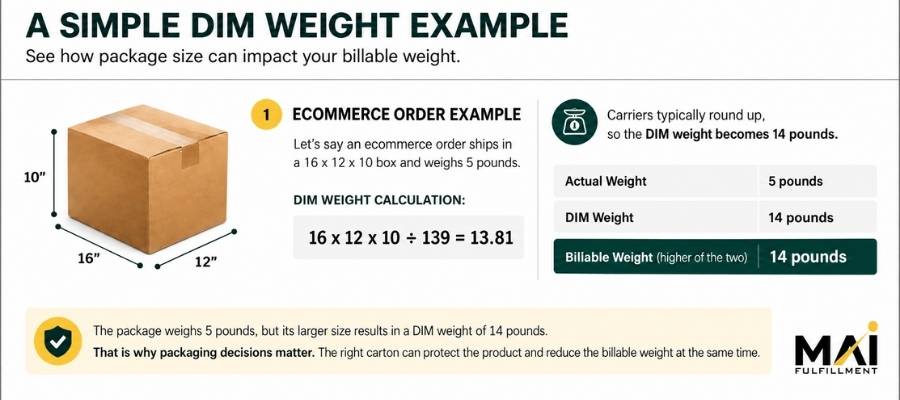
Let’s look at an example using a common divisor of 139.
An ecommerce order ships in a box measuring 16 × 12 × 10 inches. The packaged order weighs 5 pounds.
Illustrative calculation using a divisor of 139 for a shipment subject to dimensional weight pricing.
The order weighs only 5 pounds, but its dimensions produce a billable weight of 14 pounds. That’s nine additional pounds influencing the shipping charge.
The takeaway is simple. A lightweight product does not always mean a low-cost shipment.
DIM Divisor Comparison for UPS, FedEx, and USPS in 2026
Not every carrier uses the same divisor. Even within the same carrier, the divisor can vary based on the type of rates or shipping agreement.
Understanding the differences helps you evaluate shipping costs more accurately.
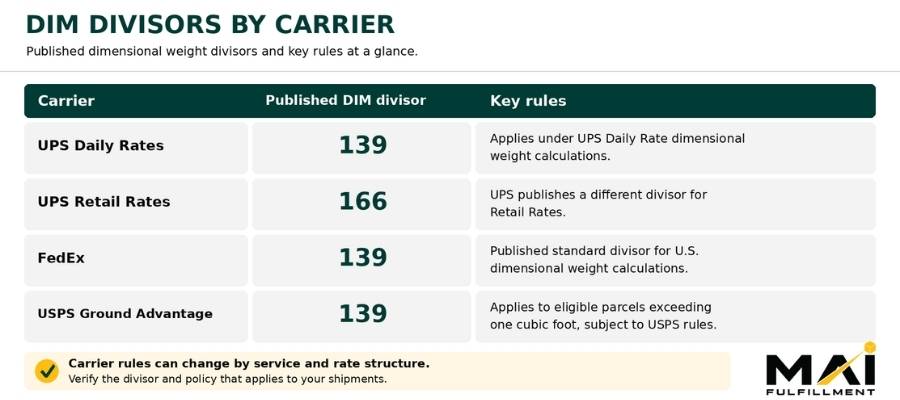
Published U.S. carrier rules reviewed October 2026. Divisors are not shipping prices per pound. Negotiated agreements and service-specific terms may differ.
Official carrier sources:
• UPS Shipping Dimensions and Weight
• FedEx Dimensional Weight Guide
• USPS Ground Advantage Retail Standards
• USPS Ground Advantage Commercial Standards
UPS explicitly publishes 139 for Daily Rates and 166 for Retail Rates. FedEx publishes a divisor of 139. USPS applies 139 to qualifying Ground Advantage shipments exceeding one cubic foot.
These differences matter, but the lowest dimensional weight doesn’t automatically mean the lowest shipping cost.
A carrier with a more favorable divisor may still have higher base transportation rates, surcharges, or minimum charges. The better comparison is what you’re paying for the fully packed order, using the services and zones your customers actually require.
What Changed With USPS DIM Weight in 2026?
Effective July 12, 2026, USPS updated its Ground Advantage dimensional weight calculation to use a divisor of 139 for eligible packages, replacing the previous divisor of 166.
For rectangular parcels, USPS Ground Advantage generally applies dimensional weight pricing when the package exceeds one cubic foot, or 1,728 cubic inches, for the applicable destinations.
That change means qualifying packages can have a higher calculated dimensional weight even when their physical size and actual weight have not changed.
Consider a package measuring 20 × 14 × 10 inches, with a physical weight of 8 pounds.
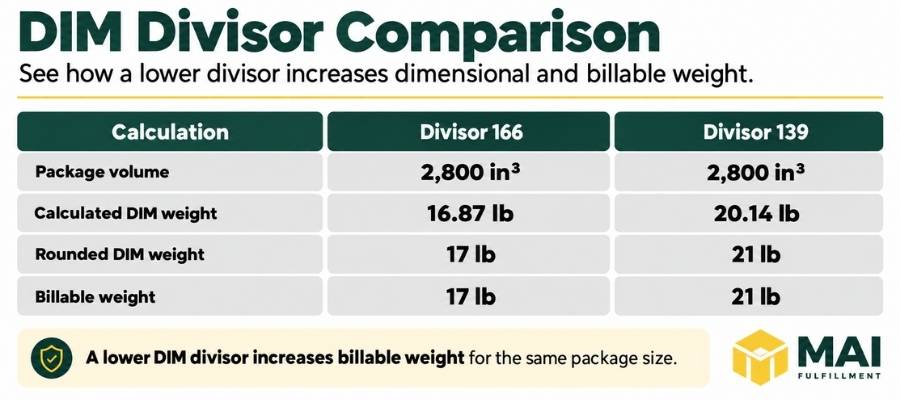
In this example, the divisor change increases the billable weight by four pounds. It does not automatically mean a four-pound increase in the dollar cost of shipping. The actual price difference depends on the applicable rate schedule.
For ecommerce brands shipping larger, lightweight products through USPS Ground Advantage, this is a reason to revisit packaging choices and cost assumptions.
Source: USPS Postal Explorer, Ground Advantage Dimensional Weight Rules.
How a Lower DIM Divisor Can Affect Shipping Margins
The DIM divisor changes the calculated weight of a package, but the impact on your business depends on how frequently that package ships.
Consider a subscription box that ships 2,000 times per month. If its packaging creates an unnecessary dimensional weight charge, that cost repeats with every shipment.
DIM Weight Calculator
Enter your package dimensions and actual weight to see how dimensional weight affects billable weight.
9 additional billable pounds compared with actual weight.
Estimates only. Actual carrier billing depends on service, measurement rules, rounding, and contractual terms.
Illustrative savings only. Actual results depend on carrier rates, shipping volume, packaging and whether dimensional weight affects the billed charge.
Shipping costs rarely become a problem because of one package. They become a problem when the same inefficient packing decisions repeat at scale.
That’s particularly important for brands offering free shipping, where the cost of fulfillment and delivery is already built into product pricing or absorbed by the business.
A small increase in cost per shipment can quickly affect the profitability of certain products, bundles, or promotions.
The opportunity is to understand which shipments are creating unnecessary expense before those costs become part of your normal operations.
Where Dimensional Weight Creates Unnecessary Shipping Costs
The problem often starts long before a carrier calculates the billable weight.
It starts with the packaging available at the fulfillment station and the decisions made about which box to use.
Oversized Boxes for Small Orders
When a fulfillment operation relies on too few carton sizes, products can end up in boxes that are larger than necessary.
The extra space may seem insignificant, especially for a single shipment. But larger dimensions increase the package’s cubic volume and may push it into a higher billable weight.
The solution isn’t necessarily adding dozens of box sizes. It’s identifying the most common order profiles and having packaging options that fit those orders without slowing down the packing process.
Too Much Packaging or Void Fill
Protective packaging matters, particularly for fragile cosmetics, electronics, or premium products. But excessive empty space can increase dimensional weight without improving protection.
The goal is to use the right amount of protection in the smallest practical package.
Smaller packaging also needs to be tested for damage risk. Saving on postage doesn’t help if more products arrive damaged and require replacements.
Bundles and Subscription Boxes That Outgrow Their Packaging
Product bundles can increase average order value, but their shipping economics are easy to overlook.
A bundle that looks profitable on the website may require a larger carton, additional inserts, or more protective material than the individual items.
The same is true for subscription boxes. Branded packaging that worked for an original product assortment may become inefficient as the contents change.
Before launching a new bundle or recurring shipment, test the fully packed order. The final dimensions may reveal costs that aren’t obvious when you’re reviewing individual product weights.
For brands managing complex product combinations, consistent kitting and fulfillment processes can also help standardize how products are assembled and prepared for shipping.
Inconsistent Packing Decisions
Two identical orders shouldn’t routinely leave the warehouse in significantly different-sized boxes.
When carton selection depends entirely on individual judgment, packaging costs become harder to predict.
Clear packing instructions, defined carton choices, and accurate product information help create consistency. That becomes especially valuable during peak season, when teams are moving quickly and order volume is high.
How to Audit Your DIM Weight and Identify Cost Opportunities
You don’t need to overhaul your entire packaging operation to find opportunities for improvement.
Start with shipment data.
The most useful review compares what the products actually weigh with what the carrier bills for those shipments. From there, you can identify which packaging choices are responsible for the largest differences.
A practical DIM weight audit should focus on four areas.
1. Identify shipments billed above their actual weight
Review recent shipping records for physical weight, package dimensions, billed weight, carrier, service, and shipping cost. Focus on shipments where dimensional weight is significantly higher than actual weight.
2. Group orders by SKU, bundle, and carton size
Look for repeated patterns. A single high-volume SKU using an oversized carton may offer more savings potential than dozens of infrequent shipments.
3. Test alternative packaging against the actual rate
Compare the current package with a smaller, practical alternative. Recalculate dimensional weight using the applicable divisor, then check whether the change reduces the shipping charge after accounting for materials and labor.
4. Prioritize changes by shipment volume and savings potential
Start with packaging improvements that can be repeated consistently. Measure the results to confirm that shipping savings aren’t offset by higher packaging costs, slower throughput, or more damaged shipments.
An audit should also account for where shipments are going.
Zone, delivery area, service level, and additional handling charges can change the final cost of an order. This is why comparing divisors alone won’t tell you which carrier or fulfillment approach is most economical.
For a more complete picture of charges beyond dimensional weight, see our guide to 3PL pricing and hidden fulfillment costs.
Packaging Changes That Can Reduce DIM Weight Charges
Once you identify where dimensional weight is affecting your shipping costs, the next step is building more efficient packaging practices.
Not every shipment needs a custom packaging solution. Often, a few targeted changes can improve performance across a large percentage of your orders.
Right-Size Packaging for Your Most Common Orders
Review the packaging used for your highest-volume SKUs and order combinations.
If those shipments regularly have unused space, determine whether a smaller carton can provide the same protection.
Even a modest reduction in package dimensions can affect the calculated dimensional weight. Depending on the carrier and service, it may also help keep a shipment below certain size-related thresholds.
Consider Mailers When Products Allow
Some apparel, accessories, and soft goods can ship safely in poly mailers or padded mailers rather than rigid boxes.
That doesn’t mean mailers are right for every product.
You still need to account for protection, brand presentation, and carrier measurement rules. But removing an unnecessarily large box can be worth evaluating when the product doesn’t require one.
Review Packaging Before Promotions Launch
Promotional bundles, holiday kits, and subscription assortment changes can introduce unexpected packaging requirements.
Before a campaign begins, test representative orders with their final inserts, protective materials, and packaging.
This is also an opportunity to confirm that the product configuration can be packed efficiently without slowing down fulfillment during higher-volume periods.
Build Consistent Carton Selection Rules
Packaging improvements have limited value if they aren’t followed consistently.
Clear guidelines for common SKUs, bundles, and order profiles help reduce unnecessary variation between packers and shifts.
The right process should make efficient carton selection straightforward, even when order volume increases.
Why DIM Weight Is a Fulfillment Issue, Not Just a Shipping Issue
A dimensional weight charge appears on a shipping invoice, but the decision that caused it may have happened earlier at a packing station.
That connection is easy to miss when inventory, packaging, fulfillment, and shipping data are managed separately.
The more visibility you have into your order profiles and final packed dimensions, the easier it becomes to identify which workflows are driving costs.
A stronger fulfillment operation brings several pieces together.
- Accurate SKU information helps teams understand product size, weight, and handling requirements.
- Consistent pick and pack workflows reduce unnecessary variation between orders.
- Clear packaging rules support efficient carton selection.
- Shipping data helps identify recurring cost patterns and evaluate carrier options.
- Reporting gives your team a way to measure whether changes are improving actual shipping performance.
For brands selling through multiple channels, those decisions become more important.
A DTC order, subscription box, marketplace shipment, and wholesale replenishment order may each have different packaging and shipping requirements. Treating every order type the same can create costs that are difficult to spot until you review the data.
With a fulfillment partner that understands those differences, packaging and shipping decisions can support your business instead of creating another expense to manage.
How MAI Fulfillment Helps Brands Protect Shipping Margins
The right fulfillment strategy isn’t about chasing the lowest possible DIM divisor. It’s about making the packing and shipping decisions that support your business consistently.
At MAI Fulfillment, we work with established and growing ecommerce brands that need flexible operations, reliable order processing, and better control over their fulfillment workflows.
That means looking beyond the individual shipment to understand how products, packaging, order types, and shipping requirements work together.
Whether you’re managing DTC orders, preparing promotional bundles, or expanding into additional sales channels, your fulfillment process needs to keep pace without introducing unnecessary complexity.
Our ecommerce fulfillment services are designed to support accurate order processing, scalable workflows, and the operational consistency brands need as their order volumes grow.
The goal is straightforward. Keep orders moving efficiently, maintain a strong customer experience, and make better decisions about the costs you can control.
Common Ecommerce Questions About
DIM Weight
UPS publishes a dimensional weight divisor of 139 for Daily Rates and 166 for Retail Rates. Your applicable divisor may depend on your rate agreement and shipping service.
For the most accurate calculation, verify the divisor associated with your shipping account.
FedEx publishes a dimensional weight divisor of 139 for U.S. shipments.
To calculate dimensional weight, multiply the package length, width, and height in inches, then divide by 139. FedEx rounds dimensional weight up to the next whole pound.
Source: FedEx Dimensional Weight Guide.
As of July 12, 2026, USPS uses a divisor of 139 for qualifying dimensional weight calculations, including eligible Ground Advantage packages exceeding one cubic foot.
Not every USPS shipment is subject to dimensional weight pricing. The rules depend on package size, shape, service, and destination.
Source: USPS Postal Explorer.
A higher DIM divisor produces a lower calculated dimensional weight for the same package. This can reduce billable weight when dimensional weight is the determining factor.
However, a higher divisor doesn’t guarantee a lower shipping price. Carrier rates, service levels, surcharges, and delivery zones still affect the total cost.
No. Dimensional weight rules vary by carrier and service.
UPS and FedEx generally apply dimensional weight calculations to eligible package shipments, while USPS Ground Advantage uses a one-cubic-foot threshold for the applicable dimensional weight pricing rules.
The carrier’s specific measurement and billing requirements determine whether dimensional weight affects your shipment.
Yes, carriers use measurement rounding rules, but those rules are not identical.
FedEx instructs shippers to round each measurement to the nearest whole inch. UPS also publishes nearest-whole-inch measurement guidance. USPS requires measurements to be rounded up to the next whole inch for its applicable dimensional weight calculations.
These differences can affect the final result, especially for packages close to a billable-weight threshold.
A 3PL can help reduce unnecessary dimensional weight exposure through more consistent carton selection, packaging reviews, better fulfillment processes, and clearer shipping cost visibility.
The biggest opportunities often come from reviewing high-volume order profiles and improving how those orders are packed.
It’s worth reviewing dimensional weight performance whenever packaging, product assortments, carrier agreements, or shipping volume change significantly.
Regular reviews are particularly useful before peak season, new bundle launches, and major promotions, when inefficient packaging decisions can affect a larger number of shipments.
Better Shipping Margins Start Before the Label Is Printed
Understanding dimensional weight is important, but the bigger opportunity is applying that knowledge to everyday fulfillment decisions.
The box you choose, the way orders are packed, and the visibility you have into shipping performance all influence what you ultimately pay.
When those decisions are made consistently, it’s easier to control unnecessary costs without sacrificing speed or customer experience.
Ready for fulfillment that works as hard as your brand does?
Contact MAI Fulfillment to discuss how the right processes, packaging strategy, and fulfillment support can help your business grow without unnecessary operational costs.