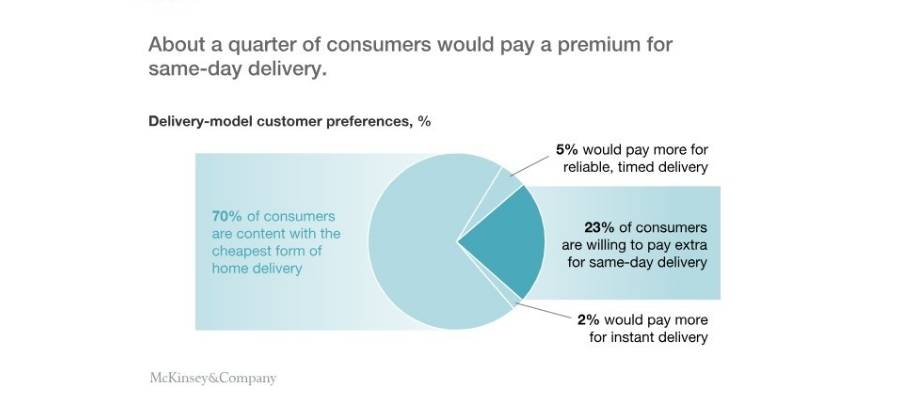
Customers have a relentless desire for their orders to be processed immediately, delivered same-day and, if needed, returns processed just as efficiently. ‘Need-it–now’ is the new mindset in the eCommerce world. In fact, a quarter of customers are willing to pay more for same-day delivery (McKinsey study).
This is quite a contrast to the mall shopping experience which requires customers to physically explore stores to locate their choices before making a purchase. Today’s eCommerce customers are now making impulse purchases and expecting instant deliveries. Adding mileage to the transformation is the ever-evolving supply chain which has made the ‘need-it-now’ mentality a mainstream reality.
If your last-mile delivery systems are not in sync with customer expectations, it may be time for a tune-up. You’ll not only improve customer satisfaction, but you’ll also gain allied benefits such as optimized inventory management, streamlined logistics and decluttering of the process bottlenecks.
Here are some key areas to fine-tune:
Anticipate demand
Last-mile delivery is a sophisticated process. Despite being the last leg in the supply chain, it is a challenging and crucial stage which demands maximum attention. What makes it so? Order volumes fluctuate and it is difficult to keep pace. Also, there is only so much scalability that last-mile delivery can provide. It cannot be scaled up quickly if the demand is not anticipated in advance.
Reference historical data to help identify regions from where maximum orders originate and plan quicker routes to reach them. The end result will be more favorable conditions for last-mile carriers as well as help in scaling up same-day deliveries.
Make data-driven decisions
Every industry that has massive scales of operation is undergoing digital-driven transformation and the supply chain is no exception. With its several stages of operations and stakeholder involvement, modern-day supply chain systems produce a large chunk of data which can be analyzed for planning a last mile delivery model that can satisfy the ‘need it now’ customer mentality.
For instance, segmenting customer demographics based on order size, purchase pattern and type of order will help identify new delivery hubs. It will also lead to a better understanding of whether the purchase is seasonal in nature or one that remains consistent across the year. Similarly, analyzing order volume by regions will help identify SKUs that sell more in specific locations. Charting a last-mile route by taking these patterns into consideration will help accelerate your last mile deliveries and meet customer expectations.
Offer omni-channel delivery methods
Another trend expected to go mainstream in eCommerce in the near future is the provision for omni-channel delivery methods. ‘Buy online and pick up in store’ and ‘try on in store and buy online’ are practices that have gained momentum recently by empowering customers to control when they receive delivery of their orders.
A common trait found among all omni-channel delivery models is that customers are increasingly willing to receive deliveries on their own. They are willing to travel to the nearest pickup point to receive their packages. Retailers can make use of this favorable condition to drive streamlined last mile deliveries that will satiate the ‘need it now’ customer mentality.
Invest in intelligent software
There are lots of ERP systems, package software and online tools available on the Internet today, but intelligent software can tie together several data points and present you with options to optimize your supply chain. Precise information like fleet availability, shipment tracking, fastest routes, empty miles and so on can help close the gap between last-mile deliveries and customer expectations.
Retail’s new challenge: I want it now!
To know more about MAI’s expertise in contact center and fulfillment services, please give us a call.
Fix your fulfillment gaps now
Build systems that scale with demand
Stay fast when volume returns