
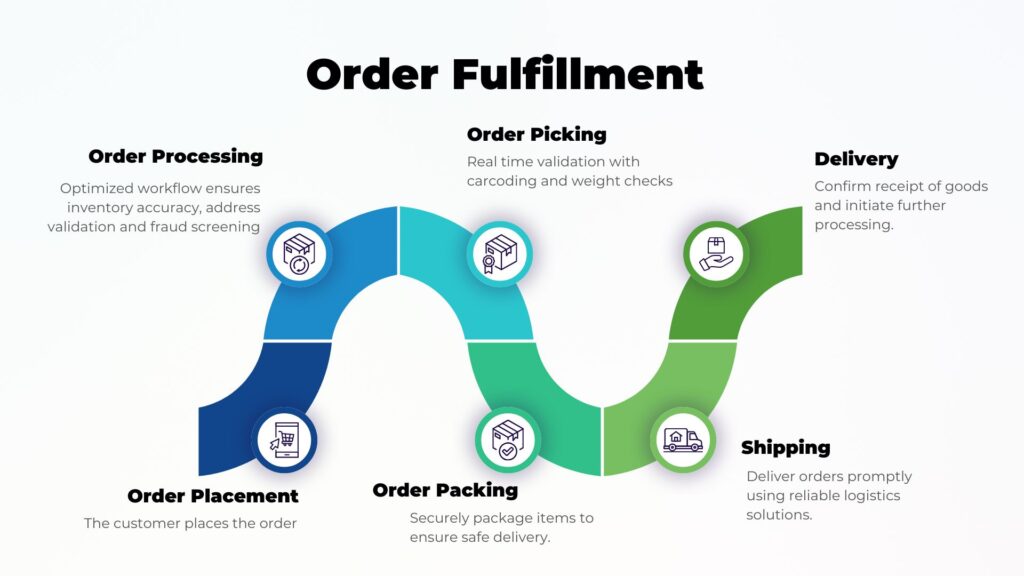
The order fulfillment process is the backbone of ecommerce operations. From the moment a customer places an order to final delivery, every step must move quickly and accurately to protect margins and customer trust. Inventory receiving, order processing, picking, packing, shipping, and delivery all work together to ensure orders move through the warehouse without disruption.
As ecommerce brands scale, small inefficiencies in the fulfillment process become costly. Delays, inventory mismatches, and manual handling errors can impact customer experience and profitability. A well-structured fulfillment workflow creates consistency across channels, improves order accuracy, and supports faster shipping without increasing operational complexity.
Inventory Receiving and Storage
The fulfillment process begins when inventory arrives at the warehouse. Products are received, counted, inspected, and logged into the warehouse management system to ensure accurate stock levels from day one. Any discrepancies are identified immediately to prevent downstream issues like overselling or delayed orders.
Once inventory is verified, products are assigned storage locations based on size, velocity, and handling requirements. Strategic placement inside the warehouse reduces travel time during picking and improves overall order speed. Proper receiving and storage set the foundation for accuracy throughout the entire fulfillment workflow.
Order Processing and System Integration
When a customer places an order, the fulfillment system captures the order details in real time. Order information such as items, quantities, shipping method, and destination is automatically transmitted to the warehouse without manual intervention. This automation eliminates delays and reduces the risk of data entry errors.
Integrated order processing ensures that inventory levels update instantly across all connected sales channels. As order volume increases, automation becomes critical for maintaining consistency and preventing fulfillment bottlenecks during peak periods.
Picking Items for Each Order
Picking is the process of retrieving the correct products from warehouse storage to fulfill each order. Accuracy at this stage is critical, as picking errors directly lead to returns, reshipments, and customer dissatisfaction. Optimized picking workflows guide warehouse staff through the most efficient routes.
Batch picking, zone picking, or single order picking methods may be used depending on order volume and product mix. The right strategy improves speed while maintaining precision, especially for brands managing a large number of SKUs or bundled products.
Signs You Have Outgrown Your Current Fulfillment Setup
Early fulfillment setups can work when order volume is low, but growth exposes every weakness in the process. What once felt manageable starts creating delays, errors, and extra labor as demand increases. If these issues show up consistently, it is usually a sign that your fulfillment operation is no longer built for the scale your business has reached.
- Orders require manual review, edits, or re entry before they can be shipped
- Inventory counts differ between your ecommerce platform and the warehouse
- Peak season or promotions create bottlenecks you do not see the rest of the year
- Your team spends more time fixing fulfillment mistakes than improving operations
- Shipping performance varies by carrier, region, or day of the week
- Customer complaints increase around delivery timing or order accuracy
Packing and Quality Control
After items are picked, orders move to the packing stage. Products are packed securely using appropriate materials to protect them during transit while minimizing excess packaging. Branded packaging, inserts, and kitting configurations are often applied at this step.
Quality control checks occur before orders are sealed and labeled. Verifying items, quantities, and packaging ensures orders leave the warehouse exactly as expected. Consistent packing standards help reduce damage, returns, and customer service issues.
Shipping and Carrier Handoff
Once packed, orders are labeled and sorted based on carrier and service level. Shipping decisions are influenced by destination, delivery speed, and cost efficiency. Automated rate selection helps balance transit time with shipping expenses.
Orders are then handed off to carriers for final delivery. Accurate labeling and carrier compliance at this stage are essential to prevent delays, lost packages, or delivery exceptions that impact customer satisfaction.
Delivery and Post Shipment Visibility
The fulfillment process continues beyond shipment. Tracking information is generated and shared with customers so they can monitor delivery progress in real time. Visibility after shipment reduces customer inquiries and builds trust in the brand.
Delivery performance data also feeds back into fulfillment operations. Monitoring transit times, delivery success rates, and carrier performance helps ecommerce brands refine shipping strategies and improve the overall customer experience.
What a Modern Fulfillment Process Should Deliver
A strong fulfillment process is not just about moving orders out the door. It should create consistency as volume grows, reduce operational guesswork, and protect the customer experience even during peak demand. When fulfillment is structured correctly and supported by the right systems, it delivers measurable outcomes that support growth instead of slowing it down.
- Real time inventory visibility: Across every sales channel, so stock levels stay accurate and overselling is avoided
- Automated order flow: From checkout to the warehouse floor, eliminating manual handoffs and delays
- Accurate picking and packing: That maintains speed without sacrificing order quality as volume increases
- Predictable shipping timelines: That align with carrier cutoffs and customer delivery expectations
- Scalable workflows: That absorb growth, promotions, and seasonal spikes without adding operational chaos
How MAI Fulfillment Supports the Order Fulfillment Process
MAI Fulfillment supports ecommerce brands at every stage of the order fulfillment process with systems and workflows designed for speed, accuracy, and scale. Inventory is received and tracked in real time through a customizable warehouse management system that connects directly with leading ecommerce platforms. This visibility allows brands to maintain accurate stock levels, reduce manual handling, and respond quickly as order volume changes.
Order processing, picking, packing, and shipping are driven by automation that reduces errors and shortens fulfillment timelines. Dedicated in warehouse support teams work directly within operations to resolve issues quickly and maintain consistency across every order. From custom kitting and branded packaging to same day shipping and carrier optimization, MAI Fulfillment helps ecommerce brands move orders from checkout to delivery with confidence and control.
How a Structured Fulfillment Process Supports Growth
A clearly defined fulfillment process creates consistency across every order and channel. As order volume grows, structured workflows prevent errors from compounding and keep operations scalable. Reliable fulfillment allows ecommerce brands to focus on marketing, product development, and customer retention.
When each step from receiving to delivery is optimized, fulfillment becomes a competitive advantage rather than a cost center. Strong fulfillment operations support faster shipping, higher accuracy, and long term growth without operational strain.
Your Questions About the Order Fulfillment Process
The order fulfillment process includes every step required to deliver a product to a customer after an order is placed. This typically includes inventory receiving, order processing, picking, packing, shipping, and final delivery. Each step must work together to ensure speed, accuracy, and a consistent customer experience.
Fulfillment timelines depend on order volume, warehouse efficiency, and shipping method. Many ecommerce orders are processed and shipped the same day or within one business day when inventory is available and systems are automated. Faster fulfillment improves delivery speed and customer satisfaction.
Technology connects ecommerce platforms directly to warehouse operations. Automated systems manage inventory levels, route orders for picking, generate shipping labels, and provide real time tracking. This reduces manual work, lowers error rates, and supports higher order volumes.
Accurate inventory management prevents overselling, stockouts, and delayed shipments. Real time inventory visibility ensures orders can be fulfilled as promised and helps ecommerce brands plan replenishment and promotions without operational risk.
Many fulfillment providers offer custom packaging, inserts, and kitting services. These capabilities allow brands to create subscription boxes, bundles, and branded unboxing experiences while maintaining efficient warehouse workflows.
Outsourcing fulfillment becomes valuable when order volume increases, shipping requirements become more complex, or internal operations limit growth. A structured fulfillment partner can improve speed, accuracy, and scalability without adding internal overhead.